
 Monitoring in CAF
GRMG Background
In a typical web server, the Web AS transfers Generic Request and Message Generator (GRMG) requests as an HTTP POST request to a servlet or iView on a servlet engine or PRT. This request is received and processed by a GRMG application on a J2EE server, web server, or PRT. An example of this workflow is described in the figure below.
The GRMG application test the different technical components and business processes, for example the availability of EJBs, web pages, data bases, or SAP systems such as R3. The GRMG response is transferred back to the GRMG framework, this is typically the output stream of the GRMG response. It may also be uploaded into the servlet or iView.
GRMG consists of the following parts:
1. GRMG Framework
¡ Is embedded in CCMS
¡ Is maintained by an SAP CCMS administrator or developer
¡ Sends test requests against the GRMG application
¡ Receives responses from the GRMG application.
2. GRMG Application
¡ Is a callable application (built-in JSP, servlet, iView, etc.)
¡ Has well-defined interfaces to receive GRMG requests and to send GRGM responses.
What To Test
To test availability of CAF, the following components need to be tested:
¡ EJB container service
¡ Web Dynpro runtime service
¡ JMS service
¡ JDO connector service
¡ MMR library
¡ MP service
¡ Web Services container service
¡ Exception Framework library
¡ SAP Logging API library
¡ KM Proxies application
GRMG Monitoring Scenario
The GRMG framework periodically calls a GRMG application that tests the availability of a chain of different software components, for example J2EE servers or Web Application Servers, or technical functions. The GRMG application is contained or called in a servlet or iView in the Enterprise Portal (EP). GRMG requests and responses are supplied in well-formatted XML documents.
The figure below describes a typical GRMG test scenario.
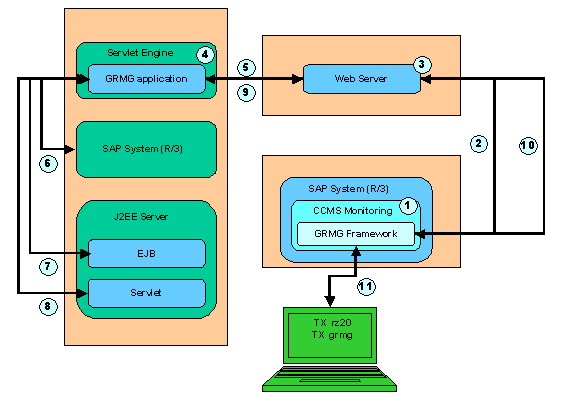
The steps in the figure can be described as follows:
The GRMG framework within the CCMS (1) periodically sends a GRMG request (2) to the central Web Server (3), which in turn transfers to the servlet engine (4) the GRMG request by an HTTP POST request (5). The tests for the different technical components or business process steps are implemented in the GRMG application
The GRMG application checks the availability of an SAP system (6), of an EJB (7), and of a servlet (8). The results of the different checks are colleted by the GRMG application and combined in a GRMG response. The RMG response is transferred back (9) to the GRMG framework (19) where it is accordingly interpreted and displayed in a CCMS monitoring tree (11).