
 Transformation
Use
The transformation process allows you to consolidate, cleanse, and integrate data. You can semantically synchronize data from heterogeneous sources.
When you load data from one BI object into a further BI object, the data is passed through a transformation. A transformation converts the fields of the source into the format of the target.
Features
You create a transformation between a source and a target. The BI objects DataSource, InfoSource, DataStore object, InfoCube, InfoObject and InfoSet serve as source objects. The BI objects InfoSource, InfoObject, DataStore object and InfoCube serve as target objects.
The following graphic illustrates how the transformation is integrated in the dataflow:
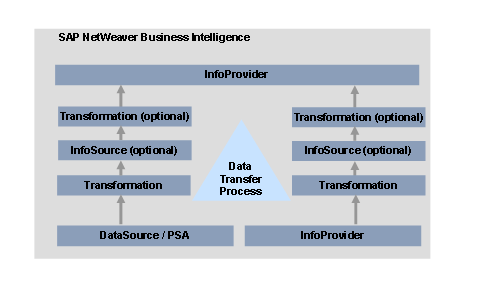
A transformation consists of at least one transformation rule. Various rule types, transformation types, and routine types are available. These allow you to create very simple to highly complex transformations:
● Transformation rules: Transformation rules map any number of source fields to at least one target field. You can use different rules types for this.
● Rule type: A rule type is a specific operation that is applied to the relevant fields using a transformation rule.
For more information, see Rule Type.
● Transformation type: The transformation type determines how data is written into the fields of the target.
For more information, see Transformation Type.
● Rule group: A rule group is a group of transformation rules. It contains one transformation rule for each key field of the target. A transformation can contain multiple rule groups.
Rule groups allow you to combine various rules. This means that you can create different rules for different key figures for a characteristic.

The source contains three date characteristics:
■ Order date
■ Delivery date
■ Invoice date
The target only contains one general date characteristic. Depending on the key figure, this is filled from the different date characteristics in the source.
Create three rule groups which, depending on the key figure, update the order date, delivery date, or invoice date to the target.
● Routine: You use routines to implement complex transformation rules yourself. Routines are available as a rule type. There are also routine types that you can use to implement additional transformations.
For more information, see Routines in Transformations.