
 Project Accounting with PS
Purpose
You can use this business process to plan, budget, and monitor the costs and revenues of a project. Project accounting fulfills different purposes in different phases of the project:
· It helps you calculate the level of costs and the expected revenues when planning a project.
· Once the costs have been approved, it forms the basis for allocating the budget.
· During project execution, you use it to monitor and check variances in the costs.
Prerequisites
You have created a work breakdown structure with WBS elements or a network, according to the Hierarchy Planning, Easy Cost Planning, Detail Planning, or Network Costing planning method.
Process Flow
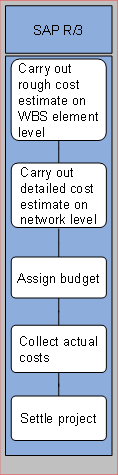
The following business process runs in SAP ERP:
...
1. Carry out rough cost estimate on WBS-element level
The system provides hierarchical cost planning at work breakdown structure level for a preliminary rough estimate of the costs and this estimate is used to assign standards. If you work without networks, you can carry out simple quantity-based planning using the Easy Cost Planning costing method. You enter the cost-causing variables from the project structure in predefined planning forms.
2. Carry out detailed cost estimate on network level
Network costing is the appropriate planning form if enough project information is available to plan dates and resources via network activities so that you can determine the costs for each activity using the information stored in the system (prices, purchasing info records, and so on).
3. Assign budget
After the planning phase, a project is approved and a budget is allocated to it. The budget is binding and therefore differs from cost planning. The budget is allocated on the basis of WBS elements and you can keep it up-to-date with the latest project status using the budget update function. The availability control can always provide you with an overview of the means available.
4. Collect actual costs
Commitments and actual costs are incurred for your project during the realization phase. The actual costs in your project result from confirmations, postings from financial accounting, such as posting travel costs, and from internal activity allocations and goods movements. Commitments are expected costs that are incurred, for example, by entering an order; these costs then decrease again at goods receipt
5. Settle project
The planned or actual costs and planned or actual revenues (goods withdrawals or receipts, vendor invoices, customer invoices, internal activity allocations) incurred in a project are settled wholly or partly for one or more recipients. The settlement transfers the costs or revenues to financial accounting, Asset Accounting, profitability analysis, and Controlling.
Result
Precise cost planning and monitoring the costs will result in a successful project.