 Proxy Type
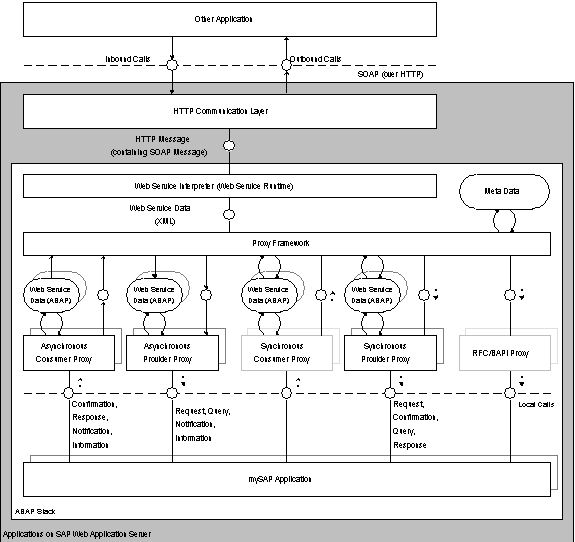
A Web service proxy, or proxy, is the implementation of a Web service interface in the Web Service Enabling Layer. Different types of proxies are used to implement the communication patterns, introduced in the previous section, in the inbound and outbound scenarios.
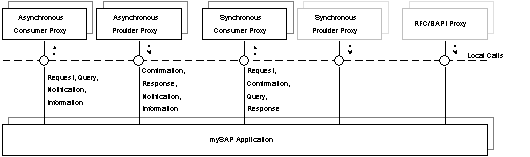
The first figure illustrates the proxy types used in the inbound scenario. The second figure shows a slightly modified version of the lower part of the first. It depicts the proxies used in the outbound scenario.
Proxy Types Used in the Inbound Scenario
Proxy Types Used in the Outbound Scenario
 Note
Note
The names of the proxy types used in this document are the names used in SAP NetWeaver NewYork. In SAP NetWeaver 2004s the proxy types are called client (consumer) and server (provider) proxy.
Proxy Type |
Proxy |
|---|---|
Asynchronous Proxies |
These proxy types send or receive asynchronous Web service calls.
|
Synchronous Proxies |
These proxy types send and receive synchronous Web service calls.
|
2 RFC/BAPI Proxies |
This proxy type wraps an existing RFC/BAPI or function group as Web service. Therefore, an RFC/BAPI proxy also is a synchronous provider proxy. However, this proxy is depicted separately in Figure 2–7 Proxy Types used in the Inbound Scenario
RFC/BAPI proxies are generated automatically without any further need of implementation effort. This is why they are not visible in the development environment. However, it is necessary to define a virtual interface for these proxies. This allows to hide specific parameters of an RFC/BAPI call in a Web service. It is, for example, possible to set default values for parameters which should not be available in the Web service. End of the note. |
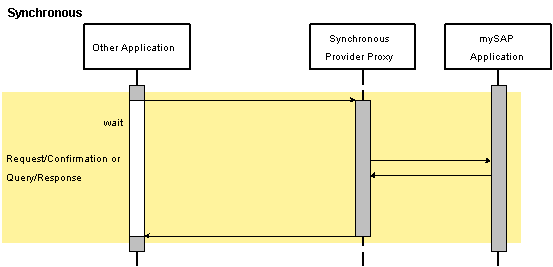
In the two figures above, the messages types (see Communication Pattern) that can be sent or received by each proxy type are shown next to the channels connecting the proxies and the SAP applications. The usage of the proxies in the communication patterns are shown in the two figures below. All patterns, except the notification and information patterns, are depicted in the inbound scenario. If used in the opposite direction, the consumer/provider proxies have to be replaced with their counterparts.
The first figure below shows the communication patterns available in the synchronous scenario, while the second shows the communication patterns available in the asynchronous scenario.
Usage of Proxy Types in Synchronous Scenarios
Use of Proxy Types in Asynchronous Scenarios
