 Customer Lifetime Value Analysis: 1 SAP BW, 1 SAP CRM, and 1 SAP R/3
Customer Lifetime Value Analysis: 1 SAP BW, 1 SAP CRM, and 1 SAP R/3
Purpose
The actual function for
Customer Lifetime Value Analysis (CLTV Analysis) is executed in the SAP Business Information Warehouse (SAP BW) and is based on data that is stored there. If your system constellation incorporates SAP BW, SAP Customer Relationship Management (SAP CRM), and SAP R/3 Financials (with the productive component Profitability Analysis (CO-PA)), the integration of these systems means you have access to all the necessary data for performing CLTV analysis. This system integration allows you to achieve a closed loop scenario, whereby all data relevant for the CLTV analysis is transferred from OLTP systems into SAP BW for processing, and then applied in the OLTP system for operational processes.This section of the documentation describes the process for this closed loop scenario and explains how you can set it up.

If your system environment does not include any other systems apart from SAP BW, CLTV analysis can nevertheless provide you with useful information. However, you need to ensure that the data required for the analysis is available in SAP BW.
Prerequisites
Technical Prerequisites
Customizing Prerequisites
 Connection Between Source Systems and BW). Furthermore, it is important that you extract CRM data regularly into SAP BW.
Process Flow
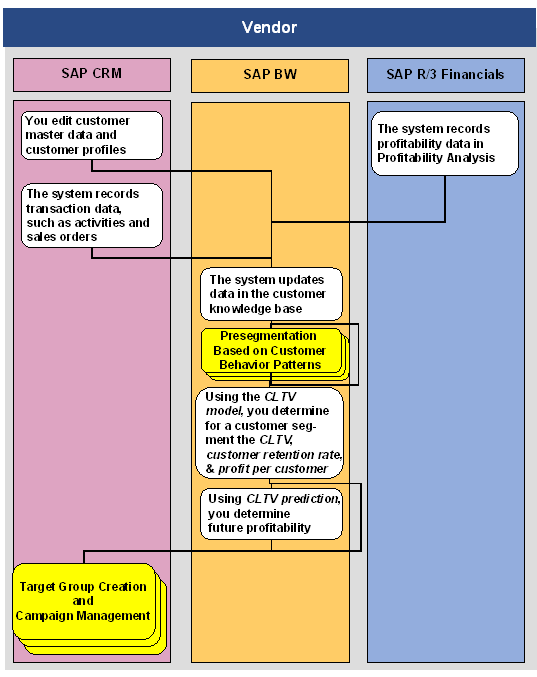
SAP CRM
SAP R/3 records profitability data in Profitability Analysis.
All of the above data relating to your customers, captured in this way in the different systems, is combined in SAP BW and forms the basis for the presegmentation.
All available customer data is combined in a virtual database in SAP BW called the
You can use the data mining method
Clustering to create homogeneous customer segments and to set the result in an InfoObject that is an attribute for the customer. You can use this InfoObject as a segmentation characteristic in the next step. However, you can still use any other characteristic InfoObject instead.
For this, you use a segmentation characteristic to specify the customer segments. The system determines the key figures for each customer segment and the
For more information, see
CLTV Model.You also have the option of using the results obtained as the basis for predicting the future profitability of a customer segment. For more information, see