
 Data Archiving
Data Archiving is an important component of an effective Information Lifecycle Management (ILM) strategy. It is one of the three main components of ILM. Its main focus is the reduction of data volume in the system. To achieve this, the following processes are used: monitoring, analyzing and categorizing, archiving and postprocessing.

As previously, it is possible to use conventional data archiving independently of ILM. Data Archiving for ILM has been expanded to enable integration of the other two main components. These enhancements will be activated as part of the switch to ILM.
The Data Archiving Concept
Data Archiving is a secure and reliable process in which data from concluded business processes (data that is no longer required in online operation) is written from the database into the archive or into an archive store for XML-based archiving (see Architecture of the Scenario Variant) and then deleted from the database. As an option, the archived data can then be stored in an external storage system (ADK-based archiving). An important aspect of this process is that the archived data can be called at any time if it needs to be read again, for example, as part of an audit or for business reasons. Data Archiving provides various functions for this.
In terms of complying with the relevant legislation, some data can or must be deleted as soon as the legal retention period has elapsed. This scenario variant provides various functions that enable archived data to be stored separately according to certain criteria in order to simplify the deletion of this data at a later stage.
Advantages
As an important part of every data management strategy, Data Archiving helps companies reduce the growth of data within their systems and supports companies in adhering to the legal requirements for electronic data.
More specifically, Data Archiving offers companies the following advantages:
● Higher system availability due to reduced data volume in the database
● Better use of resources due to leaner systems
● Improved system performance due to a reduction in database tables
● Support in complying with legal requirements and retention periods with greater automation and complete archiving and storage processes
Architecture
The technical basis for Data Archiving in the SAP NetWeaver Application Server is available in two technology variants.
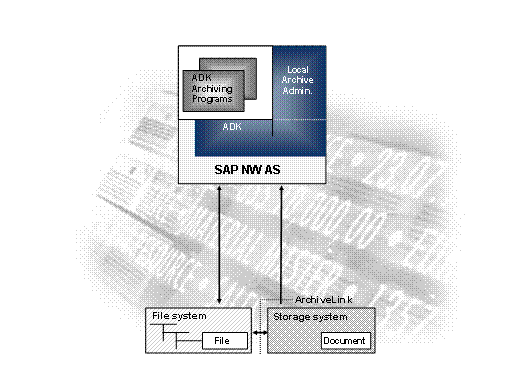
ADK-Based Archiving
ADK-based archiving is a wholly ABAP solution and is only used for ABAP archiving objects and therefore only by ABAP applications.
XML-Based Archiving
XML-based archiving is mostly used for XML archiving objects that are used by ABAP applications with XML interfaces and for archiving sets that are used by JAVA applications.

Required or Optional Installable Units
To use Data Archiving you require the following installable units:
System with activated usage types:
● Application Server ABAP
● Application Server JAVA (only for XML-based archiving)
IT Processes of Data Archiving
This process variant comprises the following IT processes:
Process |
What you should know … |
In this IT process, you monitor the behavior of the database and database tables with respect to data growth. |
|
In this IT process, individual database tables are analyzed and their content examined. Afterwards the data to be archived is categorized for the later determination of the required archiving objects. |
|
In this IT process, various system settings for controlling the archiving session are made. |
|
In this IT process, the actual archiving of data takes place. This is performed by archiving jobs. |
|
In this IT process, various tasks are performed that are necessary after archiving. |