
 Simplified Resource Planning
Purpose
Simplified resource and cost planning is based on a non-hierarchical ("flat")
itemization of product costing (this means without taking account of assemblies, only the incoming materials, services and overhead costs in the itemization are reported). You can multiply planned sales quantities with the resource input quantities available in this itemization, in order to calculate the expected consumption. You can multiply the consumption quantities calculated in this way with the prices for the individual resources, to determine the costs per resource over all sales materials or for all resources per sales material.
You have various possibilities on the basis of the calculated values:
- On the basis of existing quantity information, you can estimate in which divisions (plant, cost center, work places/jobs) great over- or under-capacity will occur. If the same products are produced in several divisions, you can make decisions for the place of production (plant, cost center...).
- On the basis of existing quantity information, you can also estimate which purchase volume is possible for the planning timeframe. You can deduce from this, whether the required quantities are compatible with the available capacities of the supplying companies, plants and so on. If in the itemization, information is contained on the suppliers, it is still possible to estimate which quantities and sales are to be expected from a supplier.
- You can make a statement regarding the assumed total cost trend, by multiplying the calculated consumption quantities with extracted, and possibly changed prices.
- You can compare various scenarios with each other, by leading a version for every scenario whose values you can compare.

The aim of simplified resource and cost planning is to first determine a "rough" impression of the future company situation before executing detailed planning. Simplified resource and cost planning does not lay claim to map planning reconciled in detail with Logistics.
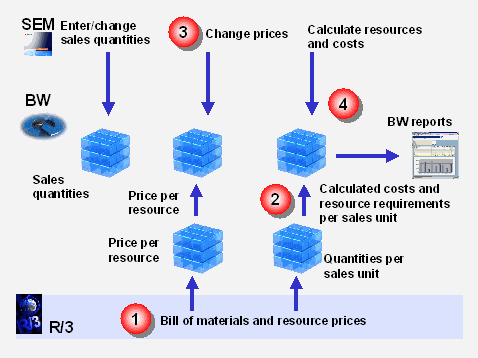
The following graphic shows the general process of simplified resource planning:
Prerequisites
Simplified resource planning is based on the following assumptions and restrictions:
- All resources are consumed at the time of sales.
- Inventories for assemblies and incoming resources are not taken into account.
- The structure of the itemization cannot be changed. However, it is possible to change the incoming quantity of a resource.
- The overhead costs change in proportion to the planned production quantity. Since these costs depend on the sales material, different from the other incoming resources, they can also be maintained on the level of the sales material.
- To enable a simple maintenance of prices, only one price is available per resource (exception: overhead costs) even when in practice the prices are different from plant to plant. The most current price for each plant material is taken as the basic price.
- If simplified resource planning is to be executed for different views, the prerequisite is that there is an appropriate costing available for every "view" (plant, profit center, group), and that this is extracted.
Process
The general process of simplified resource planning covers the following steps:
- Preparation: Maintenance of variable values, copying data into SEM-BPS InfoCubes
- Entering sales quantities
- Displaying an itemization
- Calculation of consumption quantities
- Changing the resource prices
- Calculation of costs
- Displaying valuated itemization
- Analysis of results in the SAP Business Information Warehouse