
 Forwarding Instructions for the House
Bank
Forwarding Instructions for the House
Bank

Purpose
Instructions are supplementary information in addition to manual or automatic payment data.
Instructions can be forwarded by a subsidiary company in its role as payer or from head office in its role as internal house bank.
Instructions can affect the following payment data:
· List of payment methods to be considered
· Payment method supplement
· Company code
· Group of house bank accounts
· Short key for the house bank
· Short key for the account details
· Indicator: Are you authorized to debit account?
· Key for blocking payment
· Instruction key for data medium exchange
· Forward reporting data to the house bank

Define the selection of house bank and house bank account or the division of charges.
Prerequisites
If you forward instructions by data medium exchange in several steps, all affected systems must be able to correctly interpret the instructions from the preceding systems. Note the following requirements:
· Use uniform, internal instruction codes for payments between subsidiaries and head office within your group.
This is necessary because subsidiaries do not always know which house bank is used for payment or the house bank instructions.
· Define instruction keys within your group for manual payments if necessary. Instruction keys are a combination of instruction codes that you use frequently.
For further information on Customizing settings, see Editing Instructions.
Process Flow
Instructions for the house bank pass through the following steps:
1. A subsidiary forwards a payment as a PAYEXT or DIRDEB IDoc to the internal house bank.
The subsidiary uses the internal group instruction codes.
2. The internal house bank checks whether or not it recognizes the instruction codes.

You can deactivate this check.
3. The internal house bank forwards the payment unchanged to the executing Financial Accounting system (FI system).
The internal house bank uses the internal group instruction codes.
4. The executing FI system maps twofold:
a. It replaces the internal instruction codes with its own instruction codes.
b. It replaces its own instruction codes with instructions that can be recognized by the selected house bank.
5. The executing FI system forwards the payment to the house bank.
6. The house bank makes the payment, taking the instructions into account.
Example
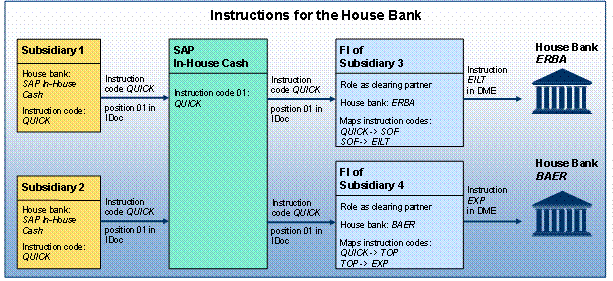
The following graphic shows payments that have instructions for rapid payment:
· Subsidiary 1 ® internal house bank ® subsidiary 3 ® external house bank ERBA
· Subsidiary 2 ® internal house bank ® subsidiary 4 ® external house bank BAER
· Subsidiary 1
a. Subsidiary 1 wants to make a rapid payment.
b. It uses the instruction code QUICK in the IDoc sent to the in-house cash center.
Prerequisite: You must have defined the instruction code QUICK in the in-house cash center in SAP In-House Cash. All subsidiaries are to use this code for rapid payments.
c. Using route processing, the in-house cash center determines that the FI system of subsidiary 3 should make the payment via house bank ERBA.
d. The in-house cash center forwards the IDoc unchanged to the FI system of subsidiary 3.
e. Subsidiary 3's FI system maps the instruction codes. It replaces the internal group instruction code QUICK with its own instruction code SOF and replaces SOF with the ERBA-specific instruction code EILT.
f. The FI system of subsidiary 3 forwards a data medium to external house bank ERBA which contains the instruction EILT.
· Subsidiary 2
Subsidiary 2’s payment follows the same logic. In this case, the payment is processed by the external house bank BAER which uses EXP to indicate rapid payments. The executing FI system replaces the internal instruction code QUICK with the BAER-specific instruction EXP.