
 Performing Automated Tests in Third-Party
Systems
Performing Automated Tests in Third-Party
Systems

Purpose
In a third-party system, you can perform an automated or semi-automated test on controls and transfer the test results to MIC.
With a semi-automated test, a tester in MIC reviews the test result taken from the third-party system and sends the test result manually.
With an automated test, no other tester is required in MIC.
Prerequisites
· There is an assignment between the MIC objects (such as control or organizational unit) and the corresponding objects in the test system. How this assignments is made (for example, whether a mapping in the Integration Builder is used) depends on the test system that you are using.
· In order that test logs can be transferred to MIC, the controls being tested must fulfill the following prerequisites:
¡ The control has the following attributes:
§ The To Be Tested indicator is set.
§ The Test Automation attribute contains the value Automated or Semi-Automated.
¡ The control is valid in the requested timeframe.
¡ The control is scheduled to be tested in the requested timeframe.
¡ The control does not have any open issues.
Process Flow
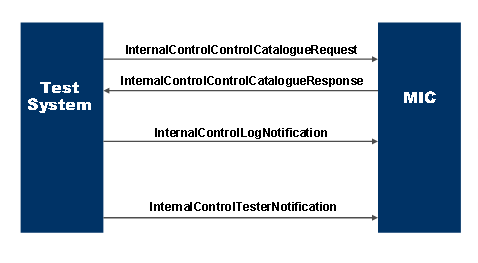
The following message types are used to exchange the data, typically in the following sequence:
...
1. The third-party system in which the tests are performed (the test system) uses the message type InternalControlControlCatalogueRequest to request the available controls that are to be tested in the test timeframe for an organizational unit.

Ensure that the test system only requests controls that are released for automated testing (GetAutomatedControlsOnlyIndicator=True).
2. MIC uses the message type InternalControlControlCatalogueResponse to deliver the requested controls to the test system.
If the control fulfills all of the above prerequisites, the system sets the control attribute IsOpenForAutomatedLogIndicator to True. However, this only occurs if, in the previous step, the test system only requested the automated controls.
3. The tests are performed in the test system.
4. The test system uses the message type InternalControlLogNotification to transfer the result to MIC in the form of a test log and, if applicable, one or more issues. The test result can be accompanied by a more detailed description, which you can transfer to MIC as a document or link.
¡ With semi-automated tests, the person assigned as tester for the control receives a workflow task.
¡ With automated tests, the system only creates a workflow task if the test result includes an issue. The recipient of the workflow task is the person assigned the role containing the task Receive Issues from Effectiveness Test (RECE-EFISO).
5. Besides the test result, other notifications can be transferred to MIC using the message type InternalControlTesterNotification (for example, when the test system has been upgraded to a higher release).
¡ With semi-automated tests, the person assigned as tester for the control receives the notification.
¡ With automated tests, the person assigned the role containing the task Receive Issues from Effectiveness Test (RECE-EFISO) receives the notification.