 Deviation Quantities and Zero Quantities

Deviation Quantities and Zero Quantities
Use
Individual customer requirements are common in the apparel and footwear industry. These requirements can be colors, sizes and fashionable cuts. They are used throughout the entire process, from the production to the components. This requires you to have different consumption quantities for the characteristic values of the components. To meet those requirements, AFS allows you to enter both deviation and zero quantities in the bill of material.
Features
When maintaining the deviation quantities of different grid values, you can consider different consumption quantities for each individual grid value during the BOM explosion. By entering zero quantities you can exclude certain grid values during the BOM explosion.

The deviation and zero quantities refer only to grid values, but not to categories.
You have the following options:
Normally the system considers the default quantities as consumption quantities for the components when exploding the bills of material during MRP. However, if you have maintained deviation quantities for certain grid values, the system will use those.
When exploding a bill of material during MRP, the system uses the consumption quantities maintained here per grid value for the components.
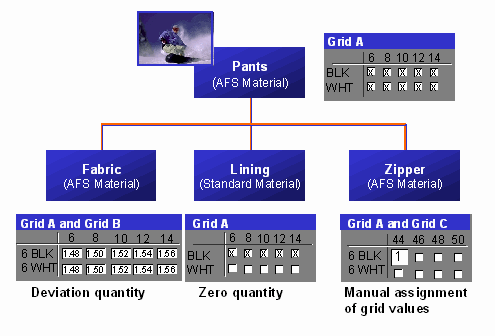

You produce ladies’ ski pants in both black and white in the sizes 6, 8, 10, 12 and 14. On average you need 1.48m of the black or white fabric for one pair of ski pants. For the ladies’ ski pants in sizes 8, 10, 12 and 14, you need 0.02m more of the fabric per size. You maintain the deviation quantities for the fabric per size and color.
Since the fabric of the white pants is slightly transparent, you produce a lining for each size of these pants, which you attach during the sewing process. You do not need a lining for the black pants and you therefore maintain zero quantities for them. For the lining you maintain the fabric consumption per size of the white ski pants.
You can also enter deviation and zero quantities standard components.