
 Profitability
Analysis
Profitability
Analysis 
Use
The CO-PA system (Profitability Analysis) is used to evaluate market segments with regard to your results contribution or contribution margin. The market segments are divided into products, product characteristics, customers, orders, and other summarizations of these terms, or organizational units such as company code or business area. The main objective of the system, from the market’s point of view, is to support Sales, Marketing, Product Management, and Business Planning by providing information for Controlling and decision-making.
Features
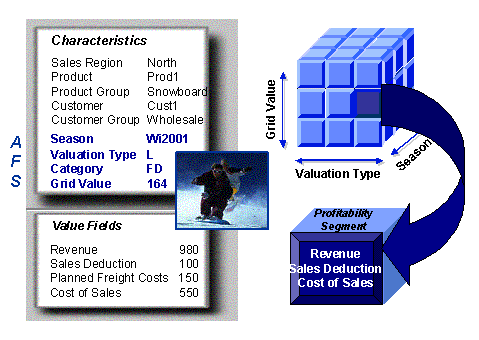
Master data and the basic structures of the profitability analysis can be customized in the CO-PA system. You specify the analysis objects (characteristics) and the analysis values (value fields) for your profitability analysis yourself. Using the combination of characteristics the system creates multi-dimensional profitability segments, with which you can plan and show a result by comparing costs and revenues.
Besides the R/3 standard characteristics such as region, customer, and so on, there is other AFS-specific information that you can integrate into the CO-PA characteristic structure. This lets you determine the result achieved by the products of a season, for example. You can also analyze the contribution of a certain grid value or grid value group to the result.

· You decide between the account-based and the costing-based profitability analysis. All AFS-specific functions are only available for the costing-based profitability analysis. Further comments on the profitability analysis in the AFS System always refer to the costing-based profitability analysis.
· If AFS materials are procured externally with standard pricing and posting of price variances to the profitability analysis (CO-PA), the system does not transfer characteristics such as “grid value”, “category”, and “valuation type” to the CO-PA component. The above also applies to variances caused by the settlement of production orders.
Integration
The profitability analysis is highly integrated with other R/3 components. The transfer of the actual data is especially important from an AFS perspective since there are enhancements to the R/3 Standard due to the AFS product structure.
The following graphic shows the most important integration links of the profitability analysis with R/3 components:

Integration of the Profitability Analysis

This section refers to the “Make-to-stock production” scenario.
In the “Make-to-order production” scenario (sales order items with costs/revenues), the transfer of the actual values to the profitability analysis is triggered by the settlement of the sales order. This settlement interface is currently not adjusted to the AFS-specific product structure. This means that AFS-specific characteristics such as grid value cannot be transferred to the profitability analysis.