 Explosion of Multi-Level Bills of Materials

Explosion of Multi-Level Bills of Materials
Use
When costing a finished product, the system explodes the bills of materials down to the lowest level. Then the system spreads the costs, separated by cost components, from the lowest level to the highest level, to determine the planned costs of the finished product.
The BOM explosion can be carried out from any production level.
Features
The BOM explosion for product costing is basically the same as the BOM explosion for production planning. The system explodes the BOM of an AFS material depending on the grid/category. The BOM definition determines (for categories it is a Customizing table) which stock keeping unit of a component is necessary for the production of a certain stock keeping unit of a finished product.
There is one special feature that is relevant for semi-finished products whose dimensions or valuation types deviate from the finished product: The product costing always explodes multi-level BOMs according to the definitions of valuation types. That means that only the preference stock keeping unit of a valuation type is used for the further explosion of a multi-level BOM.

The following example shows a finished product with three production levels. The grid value 101 of the finished product AFS FIN should be costed. According to the BOM definition, a part of the grid value 201 (AFS SEMI) is required for the production of grid value 101 (AFS FIN).
Grid value 201 is assigned to the valuation type 200. You have specified grid value 204 as the preference SKU for this valuation type. Therefore, the system does not use grid value 201, but grid value 204 for the further BOM explosion of the semi-finished product AFS SEMI.
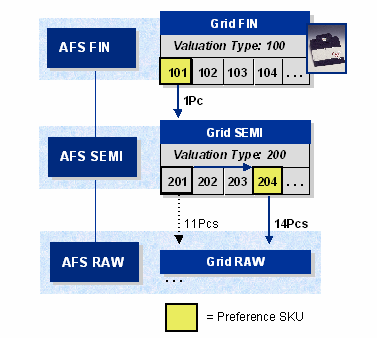
This restriction is necessary so that no costings of a non-preference SKU are saved (see

Using the function valuated BOM in the costing transaction, you can follow the BOM explosion. For this choose a display variant (function variants in the BOM display) that displays the field valuation type.