Prepacks
Use
Definition
An AFS term for sales BOMs in
which at least one component material contains a material grid. Prepacks are
not planned as units but based on their individual components. The prepack
processing (pricing, inventory management and delivery processing) is carried
out at the header level. Requirements must be created in the system only for
the header items.
Processing at header
level
So that the pricing, inventory management and delivery processing can be
carried out at the header level you must enter ERLAin the field item category group of the screen Sales 2 in the respective material master
record. In this case the components are only used as text items and are not
delivery-relevant.
In a prepack you often combine components that could be sold individually, but here they should be sold together (for example, in a sales action). For example, you can sell a shirt together with a tie as a unit. In this case, pricing, inventory management, and delivery processing should be carried out at the prepack level. It is also possible to store a material grid at the prepack level. At this level you could differentiate between the "Prepack: Business Line" (shirts and ties for business men) and the "Prepack: Casual Design" (shirts and ties in casual style).
Features
Besides the processing at main item level, the header material of the prepack normally contains a material grid. You can use one or several components. You can use both standard and AFS materials as components. Note that you cannot subordinate AFS components to an R/3 standard material. An integration of categories is possible.
Prepacks in the footwear industry
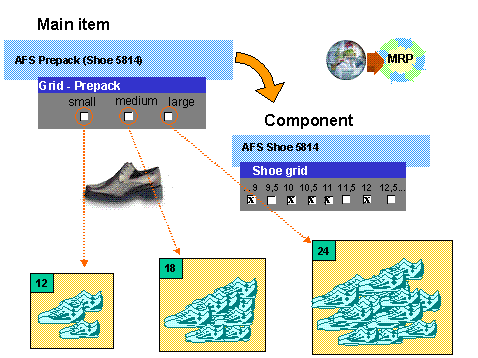
In the footwear industry shoe styles are usually sold in a specified quantity combination. For the handling of these requirements you can create a material BOM for an AFS prepack that contains only one component.

The AFS shoe 5814 is assigned to an AFS prepack as a single component. Different grid values (sizes 8 to13) and component quantities (AFS shoe 5814) are assigned to the grid values of the prepack (small, medium and large). All in all the prepack contains a specified quantity relation (for example, 12, 18 or 24 pairs), distributed among the different sizes. With the aid of the AFS prepacks you can map such quantity combinations.