 Order Scheduling

Order Scheduling
Use
Order scheduling is an additional process in AFS SD processing that helps to optimize the delivery dates for each item. You can define rules to take account of special customer requests or general business requirements.
Features
Depending on the settings for the master data and the availability check (see
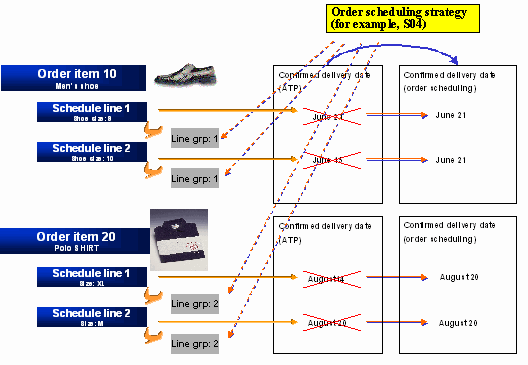
Availability Check: Control Parameters), and on the quantity of material available, there are several schedule lines with different delivery dates for the different sizes of an AFS material. Using order scheduling, schedule lines that can be delivered together are grouped in the sales order. Each grid value is assigned what is known as an AFS line group indicator. You can then use scheduling rules to determine delivery dates for these groups of schedule lines that are optimal for the customer or manufacturer.
A sales order consists of several items. A customer orders several models of shoe (for example, men’s shoes, sports shoes, ladies shoes), and different articles of clothing (for example, suit, trousers, blouse). The customer orders each article in several sizes. Due to the availability of the different sizes, the appropriate delivery dates are grouped in schedule lines (for example, June 15 through August 20). Use of an appropriate order scheduling strategy (for example,
Control Parameters for Order Scheduling
Order scheduling is an optimization process based on rules. The rules are defined in AFS Customizing for order scheduling and are grouped together in the order scheduling strategy. You can add and use your own scheduling rules.
The order scheduling strategy can be stored in the AFS additional data for the customer master or centrally in the AFS settings for the sales document type. The value from the customer master has priority over the value from the sales document type. Order scheduling can take place at the following points:

Note that when you use the order scheduling and the