 Additive Costs for Materials with Special Procurement

Additive Costs for Materials with Special Procurement
Use
This function has been developed for considering delivery costs (freight, customs) which arise due to production. These costs are often account-based costs that must be capitalized and are relevant for evaluation in Controlling. They must therefore be considered during the product costing.
This is ensured for materials that are only procured externally since the delivery costs are included in the cost price. For this it is possible in the R/3 system to store planned delivery costs in a purchase order (in price control "V" - moving average price). For materials with standard price control you can carry out a raw material costing based on the corresponding purchasing conditions (valuation strategy L).
These functions are not sufficient for materials that are not procured externally, but rather are produced internally. Generally, these materials have a standard price which can be determined using the production costing.
However, these materials also can be transferred (plant to plant) within the production process. During the stock transfer from another plant, delivery costs arise during the external procurement. These costs are not, however, automatically considered in the costing, since the costing only copies the quantity and value structures from the issuing plant (costing with SOBSL). The material must be valuated without delivery costs in the issuing plant.
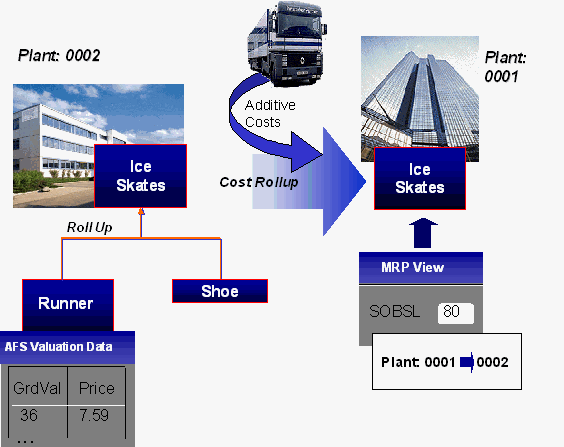
Costing with a Special Procurement Key
The function "additive costs in the standard cost estimate" closes this gap in the R/3 standard system. However, this function requires a great deal of manually data maintenance, since the additive costs for each material must be manually created with the corresponding cost components.
The raw material costing based on the purchasing conditions of the purchasing info record is not a solution either (raw material costing/valuation strategy L) because it cannot be used additively. This means that the purchase price and all other conditions from the purchasing info record of the material to be costed could be used as the basis for costing in the receiving plant. However, this results in the cost component split from the issuing plant being lost. This is generally not a desired outcome.
Prerequisites
This function is active when
You must also enter the cost element that should be used for the additive costs in a different Customizing table. No further settings in the costing / valuation variant are necessary.
Features
The AFS system offers an easy-to-use function for considering delivery costs caused by internal stock transfers. This function has the following characteristics:
This function is based on the costing of procurement alternatives (see Costing of Procurement Alternatives). It allows you to enter a special procurement class in the material master. In a Customizing table you can define for this special procurement class which special procurement key the system should use when costing a certain costing version.
In another Customizing table you can define the delivery costs that accompany the special procurement, dependent on the procurement alternative. You can enter the purchasing condition types in the table that the system should additively consider in the product costing. The product costing integrates the value of these conditions as additive costs in the cost component split at the receiving plant.
The system determines the value of the conditions according to the following logic:
The latter is especially necessary because the purchasing info record is generally not available until it has been decided which alternative should be selected for a product. The product costing should, however, be possible earlier on, since it is also a basis for this decision.