 Search Horizon

Search Horizon
Use
The search horizon (calculated in calendar days) defines the time frame during which the availability check is executed.
Features
If the replenishment lead time is activated for a material, the availability check will be executed up to the end of the RLT, if the RLT is within the time frame, or up to the end of the search horizon. The system does not consider stock and requirements that are outside the search horizon. It can be a disadvantage if sales orders that are not due for another nine months consume warehouse stock or incoming stock planned for the near future. You can use the search horizon to prevent this from happening. That way those sales orders will be ignored and the stock will not be consumed.
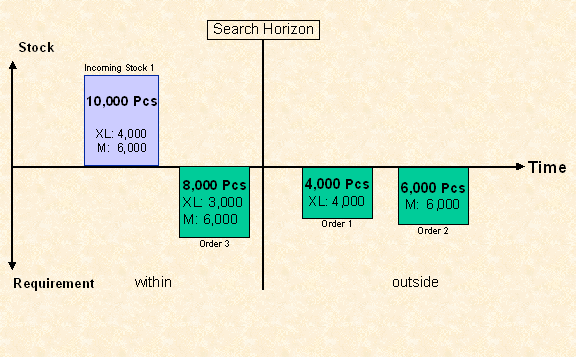 Search horizon in the availability check

Your customer would like 8,000 pieces of the material completely delivered on the requested delivery date (for example, in two days). The material is to be delivered in sizes XL (3,000 pcs) and M (5,000 pcs). If you were to run the check without the replenishment lead time, this sales order (order 3) could not be confirmed because the stock of the material has already been taken by other requirements (orders 1 and 2). If the due date of these requirements is far in the future, it might make sense to ignore them in this situation (for instance, if a procurement process could be executed soon). If you use the search horizon in the scope of check, the requirements that are outside the search horizon (orders 1 and 2) would be ignored. As a result, order 3 with a requirement of 8,000 pieces can be confirmed.

The search horizon should not be shorter than the SKU horizon (