 Determination of the Successor Product Planning Date
Use
The supersession service determines the planning date of the successor product(s) for each entry location and saves this date for each location in the master data for product and location interchangeability.
Features
To determine the successor product planning date, the system checks your entry in the master data for product and location interchangeability under
Use-up Strategy
.
If you want to work without a use-up strategy, the system sets the planning date of the successor product to the current date.
If you want to work with a use-up strategy or with a restricted use-up strategy, the system defines the planning date of the successor product as follows: The system carries out backwards scheduling from the stock exhaustion date and uses the following times to do so:
Longest delivery time of the successor product from the supplier to the entry location
Longest delivery time of the successor product within the bill of distribution (BOD) from the entry location to the subordinate stockholding location
The buffer resulting from the destocking of safety stock to a value you defined
You can define this value as a percentage of the safety stock (SFT) in Customizing for
Advanced Planning and Optimization
under
Supply Chain Planning

Service Parts Planning (SPP)
Supersession
Make Settings for Calculating Supersession Times
 .
.
The buffer in days that you defined in Customizing under
Make Settings for Calculating Supersession Times
The following graphic shows how the system schedules backwards from the stock exhaustion date by the times defined by you:
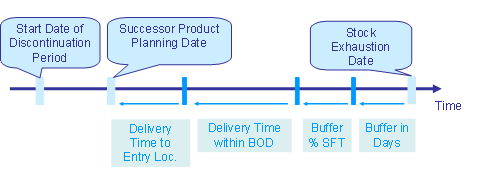
If the calculated successor product planning date is in the past, the system uses the current date as the successor product planning date instead.
Special cases:
For one-to-many substitution (AND) or (OR), the system takes the total longest delivery time of one of the successor products as the total delivery time.
For many-to-one substitution (OR), the system determines the successor product planning date for each supersession chain separately.
For one-to-one substitution with partial substitution or one-to-zero substitution, the system sets the successor product planning date to the current date.