 Calculating Tier Demands on Levels Below a Child Location
On level n of the BOD (n >2), the system only considers the tier demands that are covered by a rounded net demand and not by the initial stock or confirmed receipts within the evaluated periods. On level one and two only one net demand is calculated within the considered periods. The net demand calculation is divided into individual tiers by adding a tier zero that is the negative initial stock plus the negative confirmed receipts minus confirmed demand within the replenishment lead time. This means that the net demands caused by tier x (x > 0) can be calculated by the following formula:
net demand (x) = max (cum tier req(x),0) − max (cum tier req(x−1),0)
Process
On level n (n > 2) using the formula above is not possible, because multiple net demand calculations, including rounding steps, may be carried out within the evaluated periods. As a different approach, the system sums up the rounded net demands within the considered periods.
Starting with the lowest prioritized tier demands (tier m+1) the tier demands are considered as being covered by a rounded net demand up to the sum of the rounded net demands.
The remaining tier demands are considered as being covered by the initial stock or confirmed receipts and are not rolled up to the next level.
If the sum of the tier demands is less than the sum of the rounded net demands, the difference is treated as a demand of tier m+1.
This can happen in case of a safety stock peak before the last period, because only the safety stock of the last period is evaluated by tier processing. This logic uses the initial stock and the confirmed receipts to cover the highest prioritized tier demands inside all considered periods first.
Example
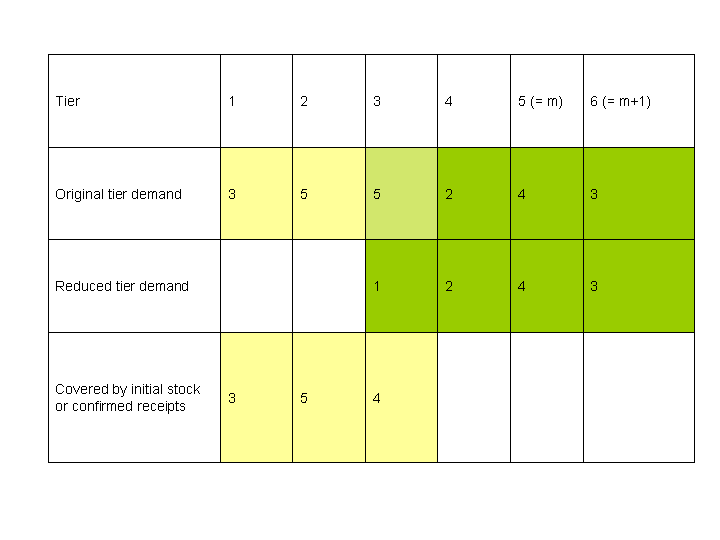
In the example above the sum of rounded net demands within the considered periods is ten. The rounded net demands within the considered periods are summed up. Starting with the lowest prioritized tier demands, tier six in the example, the tier demands are considered as being covered by a rounded net demand up to the sum of the rounded net demands. The remaining tier demands are considered as being covered by the initial stock or confirmed receipts and are not rolled up to the upper level. If the sum of the tier demands is less than the sum of the rounded net demands, then the difference is treated as a requirement of tier m+1. The system stops when the sum of the tier demands reaches the cumulated net demand. The remaining tiers, tier one and two in the example above are not relevant for the algorithm and are not calculated.