 Bringing Forward Net Demands During Shutdown Times
If you allow kit to stock only for a location product (that is, no external procurement) and an order for kitting overlaps with a shutdown time for kit to stock, the system attempts to bring forward this order, that is, to cover the kit demand before the shutdown time.
Prerequisites
You have created shutdown profiles for kit to stock in the application-specific master data for service parts planning (SPP) and assigned this shutdown profile to the required location products in the location product master data. You have made the following entries in the shutdown profiles:
You have specified a start and end date for the shutdown.
You have specified the number of periods before the shutdown across which the system should distribute the demands that occur during the shutdown. You have also specified a unit (days, weeks, months) for the periods.
For each period in which the demand should be covered in advance, you have specified the percentage of the demand to be covered within this period.
 Note
NotePeriod 1 is the period directly before the shutdown time.
End of the note.
Process
The system determines all periods that contain kitting orders that overlap with a shutdown time for kitting. The last period affected by a shutdown time is the end date of the shutdown time plus the processing time for the subcontract order or the production order for the kit.
NoteAs shown in the figure below, a kitting order overlaps with a kit-to-stock shutdown time if either the start date or end date (or both) of the order falls during the shutdown time or if the start date is before the shutdown time and the end date after.
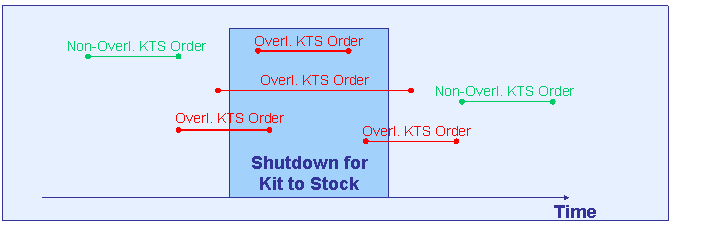
The start date for a kitting order is the date on which the dependent kit demand is removed from the warehouse. The end date of a kitting order is the date on which the demand occurs.
End of the note.The system aggregates the net kit demand that occurs during the periods determined in step 1.
The system brings forward the aggregated net demand determined in step 2 to the relevant periods in accordance with your entries in the shutdown profile.
If the system has already generated a subcontract order or production order for this kit for one of these periods, it increases the quantity by the rounded demand brought forward. If the system has not yet generated a subcontract order or production order for this kit for one of these periods, it generates a subcontracting purchase requisition or planned order using the rounded demand brought forward.
The system recalculates the projected kit stock for all periods from the first period to which it has brought forward demand for kits.