 Compact Scheduling for All Affected Orders
The following graphic explains, in the form of an example, how the system executes compact scheduling for all orders. Here the system compactly schedules all orders that are affected when rescheduling an operation.
Compact Scheduling for all Orders
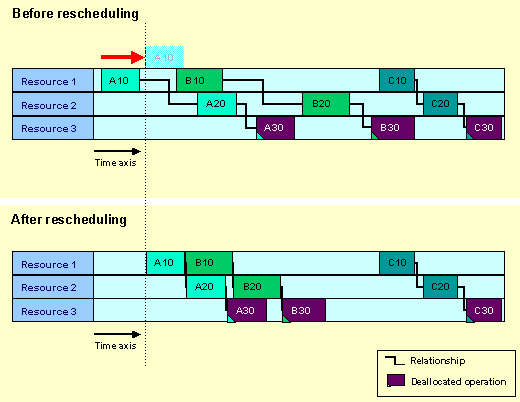
Orders A, B and C each contain the scheduled operations 10, 20 and the deallocated operation 30. The end-start relationships between operations 10 and 20, and between operations 20 and 30 are defined with a minimum interval of 0.
When you reschedule the scheduled operation A10, order A is the order selected for scheduling. The system, therefore, schedules the whole of order A compactly; that is, it tries to do the following:
Shift the scheduled operation A20 as close as possible to operation A10, taking into account the minimum interval
Shift the deallocated operation A30 as close as possible to operation A20, taking into account the minimum interval
As a result of rescheduling A10, the scheduled operation B10 from order B is affected, for example, because the planning mode
Insert operation
is set, and B10 therefore has to be shifted. Therefore, order B is also scheduled compactly; that is, the system tries to do the following:
Shift the scheduled operation B20 as close as possible to operation B10, taking into account the minimum interval
Shift the deallocated operation B30 as close as possible to operation B20, taking into account the minimum interval
Order C is not affected by rescheduling operation A10. The order is, therefore, not scheduled compactly.