 Example 1 for the Preparation Service for the LI-Based Forecast
You have assigned the following BOD to product X:
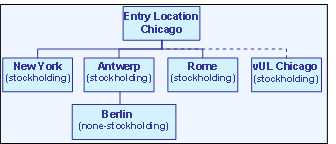
The entry location
Chicago
has the following child locations:Stockholding location
New York
Stockholding location
Antwerp
Stockholding location
Rome
Stockholding virtual child location(vCL)
Chicago
The
Antwerp
location has the non-stockholding locationBerlin
as a direct child location.
In the entry location
Chicago
you have assigned a leading indicator group, which contains the leading indicatorsInstalled Base
andNumber of Uses.
You have assigned the
Installed Base
leading indicator to product X.Product X is not part of a supersession.
In period 06.2005, the entry location
Chicago
had an aggregated demand of 9 items of product X.In the service profile for the distribution service for the leading-indicator-based forecast you have set the
Read BOM of LI
flag.In period 06.2005 you have the following equipment on the market:
Equipment
A
The demand for equipment A occurred in the
New York
location. This equipment has been assigned an equipment BOM with the following items:4 of product X
4 ofproduct Y
1 of product Z
Equipment
B
The demand for equipment B occurred in the
Berlin
location. This equipment corresponds to product X.Equipment
C
The demand for equipment C occurred in the
Rome
location. This equipment has been assigned an equipment BOM with the following items:10 of product X
8 of product Y
Equipment
D
The demand for equipment D occurred in the
virtual child
locationChicago
. This equipment has been assigned an equipment BOM with the following items:7 of product X
4 of product Z
You have not defined any selection criteria for your equipment.
Demand History for Leading IndicatorInstalled Basefor ProductX
For product X, the preparation service proceeds to determine the demand history of the assigned leading indicator Installed Base
as follows:
The preparation service reads the available equipment BOMs and counts how often product X occurs in each of these:
Equipment
A
: 4 timesEquipment C: 10 times
Equipment D: 7 times
The preparation service checks whether there is equipment corresponding to product X and determines equipment B.
Equipment B: 1 time
The preparation service determines the first stockholding locations for product X and the history of the leading indicator for the resulting location products as follows:
The demand for equipment A occurred in the
New York
location. This location is stockholding. Hence, a location product of product X is location productNewYork_X
. The demand history of the leading indicatorInstalled Base
for location productNewYork_X
is4.
The demand for equipment B occurred in the
Berlin
location. This location is not stockholding. The direct parent location of theBerlin
location is theAntwerp
location. This location is stockholding. Hence, a location product of product X is location productAntwerp_X
. The demand history of the leading indicatorInstalled Base
for location productAntwerp_X
is1.
The demand for equipment C occurred in the
Rome
location. This location is stockholding. Hence, a location product of product X is location productRome_X
. The demand history of the leading indicatorInstalled Base
for location productRome_X
is10.
The demand for equipment
D
occurred in thevirtual child
locationChicago
. This virtual child location is stockholding. Hence, a location product of product X is location productvCLChicago_X
. The demand history of the leading indicatorInstalled Base
for location productvCLChicago_X
is7.
The preparation service aggregates the values of the demand history for the leading indicator
Installed Base
along the BOD for product X as follows and thus gets the demand history for the leading indicatorInstalled Base
at entry location level:LI value
NewYork_X
+ LI valueAntwerp_X
+ LI valueRome_X
+ LI valuevCLChicago_X
=4 + 1 + 10 + 7 = 22The preparation service determines the historical value of the coefficient for period 06.2005 as follows:
Final demand for spare part X in per. 06.2005 / value of dem. hist. of LI in per. 06.2005 = 9 / 22 = 0.409