 Data Realignment for Changed Stocking/Destocking Decision
If the replenishment indicator for a location product changes, the planning service SPP: Data Real. For Stocking/Destocking
must realign the demand history data. This means for example that if the inventory planning service no longer decides to build up stock at a location for which it had planned stocking, the planning service must realign the demand history data.
 Note
Note
You can control trigger generation for the data realignment service by implementing the Business Add-In Trigger Control Based on Replenishment Indicator Change
, so that only specific changes of the replenishment indicator trigger a service run.
Prerequisites
You have scheduled the planning service SPP: Data Rea. For Stocking/Destocking
(SPP_PDEM_STOCKING_RLG
) in the Planning Service Manager (PSM). For more information, see Use of the Planning Service Manager in SPP and PSM Services for Demand History Creation.
Features
The planning service SPP: Data Real. For Stocking/Destocking
performs a general availability check for all order items that contains products in the PSM product selection. In doing so, the planning service checks whether there are new customer-facing locations or new stockholding locations for the order items. If so, it generates data realignment steps for the order items, performs them, and creates a new demand history from the changed order items.
The planning service writes the changed data to the DataStore objects 9ARAWCRT
and 9ADEMCRT
.
It also deletes the trigger SPP_REPL_INDI_CHANGE
and sets the trigger SPP_RLG_DONE
. This triggers the forecasting service.
Example
The following figure shows a two-level BOD. The entry location Montreal is on the first level. The child location Dallas and the virtual child location Montreal are on the second level. Dallas is the customer-facing location as well as the first stockholding location and the ship-from location.
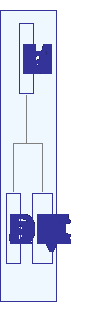
If you or the inventory balancing service now changes the replenishment indicator at Dallas from Stockholding
to Non-Stockholding
, Dallas remains a customer-facing location and a ship-to location, but the first stockholding location is now Montreal.
This means that the system must assign all sales orders with Dallas as the first stockholding location to a new stockholding location, in this case Montreal. The demand history of the location products with the locations Montreal and Dallas is therefore changed.