 Defining Optimal Amount of Historical Data in DMA Model
Use
For the forecast with the dynamic moving average (DMA) model, the system determines the optimal amount of historical data before it calculates the forecast. The system does so in various ways, depending on whether it is defining historical data for the order item forecast or for the average demand size per order item (demand/item) forecast.
Features
Optimal Amount of Historical Data for Order Items
If there were no order items in the last 26 weeks, the system sets the forecasted number of order items to zero.
If this is not the case, the system executes t-tests to determine the optimal amount of historical data.
The system tests the current 13 weeks against the previous 13 weeks. If there is a significant difference, it tests the current six weeks against the previous seven weeks. If there is a significant difference, the system uses the current six weeks for the forecast. Otherwise it uses the previous 13 weeks. If the first test does not show a significant difference, the system tests the current 26 weeks against the previous 26 weeks. If there is a significant result, the system uses the current 26 weeks. Otherwise it uses the previous 52 weeks.
Each of these t-tests (13 against 13, 6 against 7, 26 against 26) has varying acceptance limits for the significant difference. You can specify these on the
SAP Easy Access
menu under

Advanced Planning and Optimization

Service Parts Planning
Planning
Forecasting
Forecast Profile
 on the
Model Parameter
tab page in the following parameters:
Positive Significance Level T-Test 6:7 for Item in DMA Model
Positive Significance Level T-Test 13:13 for Item in DMA Model
Positive Significance Level T-Test 26:26 for Item in DMA Model
If t is less than zero, the following acceptance limits apply. You also specify these in the forecast profile on the
Model Parameter
tab page:
Negative Significance Level T-Test 6:7 for Item in DMA Model
Negative Significance Level T-Test 13:13 for Item in DMA Model
Negative Significance Level T-Test 26:26 for Item in DMA Model
The system performs the t-tests according to the following formula:
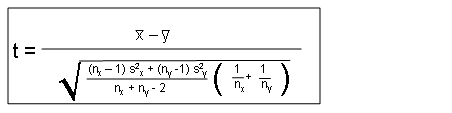
x and y are the average values of the two tests.
s x and s y are the standard deviations of the two tests.
n x and n y are the tests sizes.
(n x + n y – 2) are the degrees of freedom of the test.
Optimal Amount of Historical Data for the Average Demand Size per Order Item
If there was less than four order items in the last 52 weeks, the system uses all the 52 weeks to calculate the demand/item.
If there were four or more order items in the last 52 weeks, the system checks the following conditions:
The optimal amount of historical data for the forecast of the order items was 6 or 13 weeks and the following tests are successful.
The demand forecast per month is greater than the
Param1: Relevant Periods for Demand /Item in DMA Model
parameter in the forecast profile on theModel Parameter
tab page.The increase of the forecast order items of last month’s forecast is a least as large as the
Param2: Relevant Periods for Demand /Item in DMA Model
parameter in the forecast profile on theModel Parameter
tab page.The number of order items during the relevant historical periods for the order item forecast is at least a large as the
Param3: Relevant Periods for Demand /Item in DMA Model
parameter in the forecast profile on theModel Parameter
tab page.
If all conditions are met, it uses the same time span of historical data for the demand/item as for the order items.
If not all conditions are met, the system proceeds as follows:
If there was a minimum number of order items in each of the last two periods over 13 weeks, the system performs a t-test for these periods to determine whether the difference of the number of order items in these two periods is significant. If the difference is significant, the system uses 13 weeks as the optimal amount of historical data.
You can specify the minimum number of order items that must be available for the system to perform a t-test for the last two periods over 13 weeks in the forecast profile on the
Model Parameter
tab page in theParam4: Relevant Periods for Demand/Item in DMA Model
field.A difference is considered to be significant is it is greater than the
Positive Sign. Level T-Test 13
:13
for Item in DMA Model
parameter or if it is smaller than theNegative Sign. Level T-Test 13:13 for Item in DMA Model
. These parameters are in the forecast profile on theModel Parameter
tab page.
If the system has not calculated 13 weeks as the optimum amount of historical data, the system checks whether there was a minimum number of order items in either of the two last periods over 26 weeks. If so, it performs a t-test for these periods to calculate whether the difference of the number of the order items in these two periods is significant. If the difference is significant, the system uses 26 weeks as the optimal amount of historical data, otherwise it uses 52 periods.
You can specify the minimum number of order items that must be available for the system to perform a t-test for the last two periods over 26 weeks in the forecast profile on the
Model Parameter
tab page in theParam5: Relevant Periods for Demand/Item in DMA Model
field.A difference is considered to be significant is it is greater than the
Positive Sign. Level T-Test
26:26
for Item in DMA Model
parameter or if it is smaller than theNegative Sign. Level T-Test 26:26 for Item in DMA Model
. These parameters are in the forecast profile on theModel Parameter
tab page.