 Determining Setup Time for Sequence-Dependent Setup Activities
Use
Whether an operation has a setup activity and how high the setup time of the setup activity will be depends on the setup status of the resource at the time the operation is scheduled or rescheduled. The setup time of an operation therefore depends on which operations were previously processed on the resource.
 Example
Product A is processed with operation V1, then product B is to be processed using operation V2. The setup matrix stipulates that a setup is required between V1 and V2 which takes 10 minutes.
Therefore when scheduling or rescheduling an operation at a single-activity resource or at a single mixed resource, the system must recalculate the duration of the setup activities.
A separate setup logic is available for calculating the sequence-dependent setup activities. The basis for calculating setup activities and times is the sequence of the operations on the resource. The system determines the sequence of the operations using the start times of the processing activities. Using this sequence and the setup matrix, the system calculates the necessary setup activities with the corresponding setup time. The system creates the setup activities with the calculated durations. This means that the operation sequence no longer changes – even if an operation has an earlier start time because of setup. This is because it is only the start time of the processing activities that is relevant for the sequence of the operations. Therefore the planning situation remains very stable.
Prerequisites
In order for the system to adjust the setup times for the operations at a single resource depending on sequence, the following conditions must be fulfilled:
You use the single resource in the production process models (PPM) exclusively as a primary resource.
You have defined a setup matrix for the location.
You have assigned the setup matrix to the single resource in the master data.
You have maintained the following data in the PPM for operations that are to be setup at the single resource depending on sequence:
You defined the necessary setup status for processing the operation by assigning a setup group or a setup key to the operation.
You defined a setup activity for the operation.
 Note
NoteIf you define an operation with a setup activity, it is at the start of the operation and precedes a processing activity.
End of the note.You have set the
Setup activity
indicator for the setup activity. NoteWhen calculating setup time, the system only interprets an activity as a setup activity with a duration dependent on sequence when the
Setup activity
indicator is set for the activity. It is therefore not enough to define a sequence-dependent setup activity by assigning an activity the activity typeS (Setup)
. In the case of setup activities for which you do not set the indicator, the system uses the setup time from the mode, and not from the setup matrix; that is, the duration of the setup activity is constant and is not dependent on the sequence.End of the note.
Integration
For all planning functions in the detailed scheduling planning board, the start time no longer depends on the start time of the operation but also on the start time of the processing activity. A new planning board profile exists to support this function visually. Using the new profile, only the sequence-dependent setup activities are still only displayed in the DS planning board in the phantom object.
The calculation of the insertion point for the planning mode
Insert operation
is also based on the start time of the processing activity. If you use the planning modeInsert operation
, the system has to place the start time of the processing activity of the operation you want to reschedule before the start time of the processing activity that is to lie after the rescheduled operation after the insertion.
Features
The setup logic to calculate the activities dependent on sequence is based on two principles:
The sequence of the operations only depends on the start times of the processing activities. The setup activities only play a subordinate role in planning.
When rescheduling, the planning situation should change as little as possible. If, for example, the predecessor of an operation changes then the operation should not be rescheduled if possible. Instead, the setup time should be recalculated.
In addition, rules exist to determine how scheduling should behave in the different planning situations.
Sort according to start time, setup ID and activity ID
The sequence of the processing activities on a resource is defined uniquely by sorting according to start time, setup ID and activity ID. Even for processing activities with the same time, the system can determine the sequence uniquely using these criteria.
The setup ID and the activity ID are internal identifiers that cannot be displayed by the user. As processing activities that start simultaneously can only arise in an infinite planning run and in infinite planning, the duration of the sequence-dependent setup activities is insignificant due to the random sequence of the processing activities. The internal sorting criteria do not worsen the situation but, instead, provide greater stability.
Scheduling sequence-dependent setup activities – also in the past
When planning infinitely, sequence-dependent setup activities can also be planned in the past – that is, the start time of the setup activity may lie before the current date. However, the end time must at least coincide with the current date. This means that the current date is the earliest start time of a processing activity. If no constraint violations exist, the date/time need not be changed.
The start time of a setup activity that is recalculated due to a changed predecessor can be scheduled with both an infinite and finite planning run so that the current date is not respected. This should avoid the operation, whose setup time has changed according to the new sequence, being rescheduled as well as the rescheduled operation.
In finite planning, rescheduled operations are scheduled so that their start times lie on the current date at the earliest.
Considering the planning horizon
In scheduling, the start of the planning horizon is treated in exactly the same way as the current date.
In infinite planning, sequence-dependent setup activities may lie before the start of the planning horizon. However, they must end by the start of the planning horizon at the latest.
Setup activities dependent on their predecessors can violate the start date of the planning horizon in both infinite and finite planning.
In finite planning, rescheduled operations are scheduled taking account of the start date of the planning horizon.
Consideration of the fixing interval
Operations that lie in a fixing interval may not be rescheduled. The following rule applies to define whether an operation belongs to a fixing interval: An operation lies in a fixing interval when its processing activity lies in a fixing interval. This means that an operation whose setup activity starts in a fixing interval and ends after the fixing interval can be rescheduled.
In scheduling, the end of the fixing interval is treated in exactly the same way as the current date.
In infinite scheduling, sequence-dependent setup activities can lie before the end of the fixing interval but must end by the end of the fixing interval at the latest.
Setup activities dependent on their predecessors can violate the end date of the fixing interval in both infinite and finite planning.
In finite planning, rescheduled operations are scheduled taking account of the end date of the fixing interval.
Overlapping of operations – also for finite planning
In finite planning, the system also allows a setup activity to overlap with the processing activity of the predecessor if the rescheduling of an operation results in a new setup time that is greater than the planned duration of the operation that was rescheduled.
ExampleOperations A, B, C and D are scheduled in sequence with no gaps.
Setup A = 10 mins
Processing A = 10 mins
Setup B = 10 mins
Processing B = 15 mins
Setup C = 5 mins
Processing C = 25 mins
Setup D = 10 mins
Processing D = 15 mins
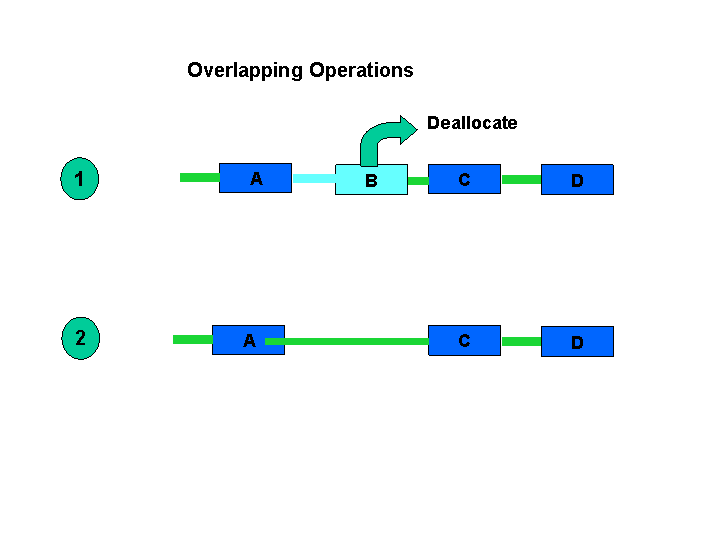
Operation B is then deallocated. Now the system has to recalculate the setup time for C as the sequence (A to C) has changed. According to the setup matrix, the setup from A to C takes 40 minutes. As the start time of the processing activity for C does not change and the new setup time is longer than the originally scheduled operation B, an overlap of 10 minutes exists between the setup activity for operation C and the processing activity for operation A.
How the system proceeds is shown in the following graphic:
 End of the example.