 Creating a Returns Forecast
In order to be able to determine available quantities of repairable products, distribution requirements planning (DRP) creates a returns forecast.
Prerequisites
You have specified the following values in the location product master data on the SPP DRP
tab page in the Kit to Stock/Repair or Buy
area:
Forecast for Repairable Returned Products
% Good Quantity of Returned Products
% Yield of Repairable Products
Return Time for Unserviceable Products
Process
DRP checks what you have entered in the "Forecast for Repairable Returned Products" field in the location master data.
If you have specified that you want to use your own forecast values, the system uses the forecast values for repairable returns that you provided. You can take these forecast values from Demand Planning (DP) in SAP Advanced Planning and Optimization (SAP APO), for example, or you can import your own forecast values for repairable returns using a Business Application Programming Interface (BAPI).
If you have specified that the system is to create this forecast based on the demand forecast, DRP uses the demand forecast created by the forecast service and proceeds with step 2.
If you have specified that you want to use the forecast based on time series, the system uses the time series profile that you specified in the location product master data as the profile for the returned products forecast based on time series and proceeds with step 2.
For more information about time series profiles for the returned products forecast, see Customizing for
Advanced Planning and Optimization
under
Supply Chain Planning

Service Parts Planning (SPP)
Distribution Requirements Planning (DRP)
Define Profile for Repairable Returns Forecast Based on Time Series
 .
.
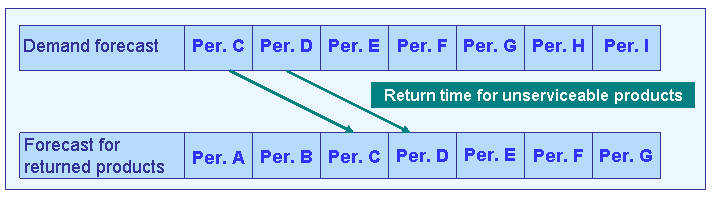
DRP creates the returns forecast for a specific period in the future on the basis of the forecast for demand in a previous period.
In order to identify which demand forecast is used as the basis for which returns forecast, the system adds the return time for unserviceable products to each demand forecast, thereby determining the relevant period for the returns forecast. The following figure illustrated this process:
DRP multiplies the demand forecast for the period determined in step 2a by the returns yield percentage and by the repairable returns yield percentage.
You specified the returns yield percentage in the
% Good Quantity of Returned Products
field and the repairable returns yield percentage in the% Yield of Repairable Products
field (seePrerequisites
).