 Planning with Future Bills of Distribution (BODs)
Purpose
If you want to plan using new bills of distribution (BODs) from a specific point in the future, distribution requirements planning (DRP) must consider these future BODs during planning. DRP checks which locations have changed position in the new BOD compared to the old one to perform the aggregation of demands within the BOD correctly. If, for example, you want to include new locations in your planning, your BOD changes. This means that as of the point in time when you consider the new location during planning, a new BOD becomes valid. You create this new BOD in the master data for bills of distribution and specify the point in time at which it becomes valid.
Process
The system determines all BODs that are valid during the planning horizon and sorts them according to their validity date.
The system compares the last valid BOD with the penultimate valid BOD.
For each location in these BODs the system compares whether the path from the entry location to the individual locations has changed. In doing so the system differentiates between the following cases:
The path has not changed.
In this case, the BOD change has no effect on the corresponding location.
The path has changed.
In this case, DRP cannot supply the BOD as of the validity date of the last valid BOD, but can only do so after the validity date plus the replenishment lead time from the entry location to the corresponding location. This means that DRP must plan that the location builds up enough stock before the BOD change to be able to cover the demands during the replenishment lead time from the entry location to the location.
A location has been added to the BOD.
In this case, DRP can only supply the new location, which only exists in the last valid BOD, as of the validity date of the last valid BOD plus the replenishment lead time from the entry location to the new location.
A location is no longer in the BOD.
In this case, DRP no longer supplies this location as of the validity date of the last valid BOD.
 Example
The following figure shows two BODs: BOD 1 and BOD2.
BOD1 is a three-level BOD with location A as the entry location. B, C, and E are on the second level of BOD1. Location C is the parent location of location D that is on the third level of BOD 1 and is a customer-facing location.
BOD2 is a four-level BOD that also has location A as the entry location. Locations B and E are on the second level of BOD2. B is the parent location of location C that is on the third level of BOD2 and is the parent location of location D. Location D is on the fourth level of BOD2.
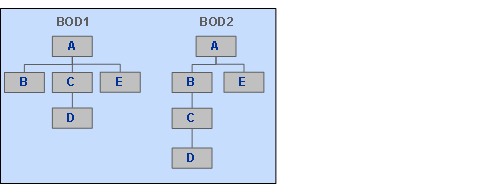
In this example, the path to locations A, B, and E are the same. The path to locations C and D has changed in BOD2.
End of the example.The system compares the BOD that was valid before the penultimate one, with the penultimate valid BOD and continues with step three. This procedure is repeated until DRP has checked all BODs within the planning horizon.