Substitution of Remanufactured Products
Purpose
If you want to include remanufactured products during replenishment planning, distribution requirements planning (DRP) considers the capacity restrictions of your suppliers. If the demand for remanufactured products exceeds the capacity of your suppliers in a certain period, DRP uses unused capacity from earlier periods to cover the demand for remanufactured products. If these unused capacities also run out and the demand for remanufactured products is still not covered, DRP substitutes the products to be remanufactured with the corresponding new products to cover the demand on time.
 Note
Note
New products in the context of substitution of remanufactured products means products that are the same as the product to be remanufactured but that have not yet been used. The remanufactured and the new, unused product have different product numbers.
Prerequisites
You have made the settings in Customizing under
Define Service Profile for DRP
andMake General Settings for DRP
in the areaSubstitution of Remanufactured Products
. In the service profile for DRP you have also set theSubstitution of Remanufactured Products
indicator in theRuntime-Critical Settings
area.For more information, see the Implementation Guide (IMG) for
Advanced Planning and Optimization
under
Supply Chain Planning

Service Parts Planning (SPP)
Distribution Requirements Planning (DRP)
Define Service Profile for DRP
 and
and
Make General Settings for DRP
.You have modeled the replacement strategy
Substitution of Remanufactured Products
in the master data for product and location interchangeability. For more information, see Master Data for Product and Location Interchangeability and Modeling of Replacement Strategies .Your suppliers have sent their capacities. These capacities were posted in the system per time unit using the Business Application Programming Interface (BAPI)
SPPRemanCapacity
.
Process
If demand for a remanufactured product occurs at an entry location, the system checks whether the specified supplier capacity suffices. If the capacity suffices, DRP covers the demand with this capacity. If the capacity does not suffice, the system continues with step 2.
DRP checks whether there are unused capacities from periods before the demand period. To do so, DRP goes back over a number of periods defined by you and checks whether there is unused supplier capacity within this time period.
You can define the number of periods that the system goes back over in the service profile for DRP in the
Validity Extension of Unused Capacity
field (see prerequisites).The number of periods is always in days. If the supplier capacity is in another unit, such as weeks or months, there are the following variants:
The supplier capacities are available on the first day of the period. If you want to work with this variant, you must not set the
Distribution of Capacity to All Days of a Period
indicator in the service profile for DRP.The system distributes the supplier capacities equally over all days in the period. If you want to work with this variant, you must set the
Distribution of Capacity to All Days of a Period
indicator in the service profile for DRP.The system covers the demands by using unused supplier capacities within this period before the current period.
DRP creates scheduling agreement delivery schedule lines. However, if the quantity of a scheduling agreement delivery schedule line is greater than the unused capacity of the supplier, DRP reduces the quantity of the scheduling agreement delivery schedule line to the supplier capacity. The system adds the remaining quantity to a provisional quantity.
NoteDRP cannot change scheduling agreement delivery schedule lines within the freeze horizon. If the quantity of scheduling agreement delivery schedule lines changes within the plan submission horizonor the limited freeze horizon, DRP generates an alert.
End of the note.After DRP has considered the capacity restrictions for all scheduling agreement delivery schedule lines of the remanufactured product, it divides the provisional quantity between the suppliers that still have capacity as follows:
DRP begins with the suppliers that already have scheduling agreement delivery schedule lines. It then continues with the suppliers that so not have scheduling agreement delivery schedule lines.
DRP adds the remaining quantity to the scheduling agreement delivery schedule line quantity of a supplier.
DRP rounds the scheduling agreement delivery schedule line to pack sizes.
If this rounded quantity is greater than the supplier capacity, the system reduces it to this capacity.
The system subtracts the quantity by which it increased the scheduling agreement delivery schedule line from the provisional quantity.
DRP repeats steps 4a to 4e until all supplier capacities available for this remanufactured product are used up.
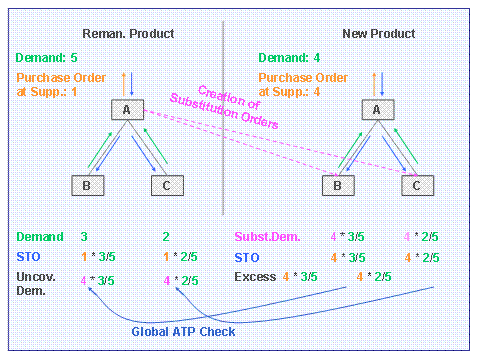
DRP generates product substitution orders for the remaining provisional quantity. To do so, DRP calculates the size of the substitution quantity at the entry location of the remanufactured product for each period. Whether the system creates one or multiple substitution orders depends on the demands at the child locations and on the bill of distribution (BOD) of the new product. The substitution quantity represents an artificial receipt at the entry location for the remanufactured product. In the DRP matrix , this helps to cover the remaining demand. DRP creates the artificial demand for the new product of a substitution order at the child location that needs the remanufactured product. When the forecasted sales order for the remanufactured product arrives, there is both a planned shortage and a planned excess for the new product. The Global ATP check can thus confirm the new product instead of the remanufactured product.
DRP disaggregates the remaining provisional quantity (meaning the whole substitution quantity) to the locations in the BOD of the new product. If the amount to be deployed is greater than the demand of the child locations, the system only disaggregates the amount equal to the demand of the child locations. DRP creates one substitution order per location that needs the new product. In doing so, DRP accredits the receipt to the entry location of the remanufactured product and the demand to the location that needs the new product.
To calculate the demand date at this location, DRP performs backwards scheduling over the replenishment lead time starting with the period in which the remaining provisional quantity is at the entry location of the remanufactured product.
DRP calculates the individual substitution quantities as follows:
For the remaining provisional quantity, DRP traces which child locations reported the net demands per DRP stock transport requisition at each parent location, and thus calculates the total quantity of these DRP STRs. To do so, the system goes one step below within the BOD and traces the supply path within the BOD.
DRP then traces the supply path described above in the opposite direction, that is, from bottom to top. In doing so, DRP checks per location whether this location also exists in the BOD of the new product at the time of demand. If so, this location receives a portion of the total substitution quantity. The size of this proportion depends on the relationship between the quantity of the DRP STRs of this location and the total quantity of the DRP STRs. The system calculates this proportion according to the following formula:

Before the system processes a parent location, it must process all child locations belonging to this parent location.
A net demand at a parent location does not only occur due to dependent demand at the child location, but also due to fixed demands or consumed safety stock at the parent location itself. If this is the case, or if one of the child locations in the BOD of the remanufactured product is not in the BOD of the new product, the system checks whether the parent location is in the BOD of the new product.
If so, the system creates a substitution order based on the remaining DRP STRs as described above.
If the parent location is not in the BOD of the new product, the system checks its parent location, and so on. When none of the locations in the supply path described above is in the BOD of the new product, DRP triggers an exception. DRP cannot process this case.
Results
This process results in scheduling agreement releases for remanufactured products as well as substitution orders that contain the substitution of remanufactured products by the corresponding new products.
You see the planning results in the
DRP matrix
under
Total Gross Demand
Substitution Demand
and under
Total Gross Demand (Confirmed)
Substitution Receipt
in the row
Substitution of Remanufactured Products
.
Example
The following figure shows how DRP proceeds for a demand for remanufactured products of five and a supplier capacity of one: