 Prerequisites for the Seasonal Test
Before the system performs a seasonal test for a location product as part of automatic model selection , it checks whether the location product fulfills the following prerequisites:
The location product must have a demand history of at least 24 periods.
Each of the previous two years must have a higher demand that the minimum annual demand. You can specify the minimum annual demand in the
Minimum Annual Demand for Seasonal Test
field in the forecast profile on theTest
tab page. You get to the forecast profile on theSAP Easy Access
screen under
Advanced Planning and Optimization

Service Parts Planning (SPP)
Planning
Forecasting
 .
.The demand of the current year is not greater than the demand of the previous year multiplied by one plus a trend delimiter. You can define this trend delimiter in the
Upper Trend Delimiter for Seasonal Test
field on theTest
tab page of the forecast profile.The demand of the current year is not less than the demand of the previous year multiplied by one minus a trend delimiter. You can define this trend delimiter in the
Lower Trend Delimiter for Seasonal Test
field on theTest
tab page of the forecast profile.The peak test is not successful.
So that peak values at the start or end of a year are not interpreted incorrectly as seasonal demand, the system performs a peak test. To do so, the system observes the demand of the previous two years. It checks whether the demand of the two halves of the previous year and the first half of the current year deviate greatly from the demand of the remaining half year. If so, this is a sign for a demand peak, but not for seasonal demand. The system performs the peak test as follows:
Based on the demand history of the previous two years, the system defines Average1 as the average demand of periods from 7 to 18.
Based on the demand history of the previous two years, the system defines Average2 as the average demand of periods from 1 to 6 and 19 to 24.
The system uses a t-testaccording to the following formula to check whether there is significant deviation between the two average values:
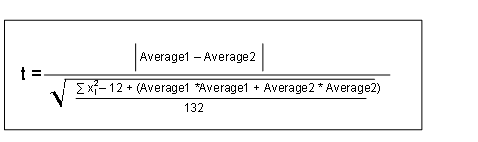
If t is less than your entry in the
Significance Level for Peak Test in Seasonal Test
field in the forecast profile on theTest
tab page, the peak test was unsuccessful.If t is greater than your entry in the
Significance Level for Peak Test in Seasonal Test
, the system continues with the peak test as follows:For each of the two years, the system calculates the gradient and the behavior of the gradient for the total annual demand as follows:
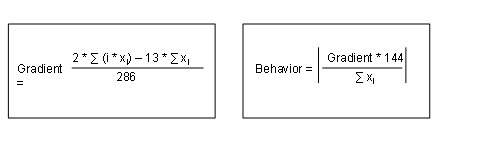
If the following conditions are met, the peak test is successful, meaning that there is no seasonal demand:
The behavior of the gradient of the total annual demand is bigger for both the current and previous year that your entry in the
Gradient Threshold for Peak Test in Seasonal Test
field in the forecast profile on theTest
tab page.The gradient in the previous year goes in a different direction than in the current year, which means that the demand at the end of the previous year increased, but the demand at the start of the current year fell.