

 Scenario - Exporting to a Third Country
Purpose
This scenario describes the processes involved in exporting goods from your country to an independent country (third country) where no trade agreement exists between your country and the importer. In this case, you are responsible for compliance with the export laws of your own country.
Reasons for Exporting Goods
Three primary reasons for exporting goods include
Consistency in Sales
Peaks and valleys in the business cycle are inevitable. When the economy of one country is on an economic downturn, the economy in other nations may be in a relatively prosperous phase. If you have customers in countries other than your own, your business profits tend to become more consistent from year to year.
Product Cycle Extension
When you export your product, the end of the product cycle is postponed. When the market in your own country is saturated, exporting allows you to introduce your product into other countries.
Considerations
Licensing
Since most goods require no licensing, you can export them freely. If your goods are not on the Commerce Control List (CCL) and there are no other restrictions, such as embargoes or your customer being listed on a sanctioned party list, you can generally trade freely without any government licensing required. Generally speaking, the only merchandise that requires a license includes
Delivery Quantity
Large quantities may require international sales agreements, special packaging and handling procedures or a particular method of payment. Additionally, special export limitations and quotas may also affect export procedures, documentation and manufacturing decisions.
Partial Deliveries to the USA
A special consideration for exporting to the USA concerns partial deliveries. A billing document for partial delivery can only be accepted if
The Product
The product that you plan to export may also affect the documentation and procedures necessary to comply with government requirements. For example, are you shipping raw materials or a finished product? Will it be used as a component in a manufacturing process? Does it need to be modified to be sold in a foreign market?
Required Information
In addition to the data normally required for shipment, the following information must be properly documented when you export goods:
This includes the description of the merchandise, goods classification, brand name and numbers and symbols under which the goods will be sold in the country of import.
Duty Drawback
In some cases, you can apply for a duty drawback for duties paid previously. This is a refund of all or part of customs duties, or domestic tax paid on imported merchandise which was subsequently either manufactured into a different article or re-exported. The drawback enables domestic manufacturers to compete in foreign markets without having to include, in the cost and sales price, the duty paid on imported raw materials or merchandise used in the manufacture of the exported goods.

In the US, 99% of duties paid on re-imported merchandise is refundable under the duty drawback program. The right to claim a drawback refund is also transferable. This means that you can claim a drawback whether the shipment is exported by the manufacturer, subsequent customers or agents.
Export Process
The export process illustrated and described below answers the following questions:
For information about the process of exporting merchandise involving a letter of credit, see
Scenario - Export Involving a Letter of Credit.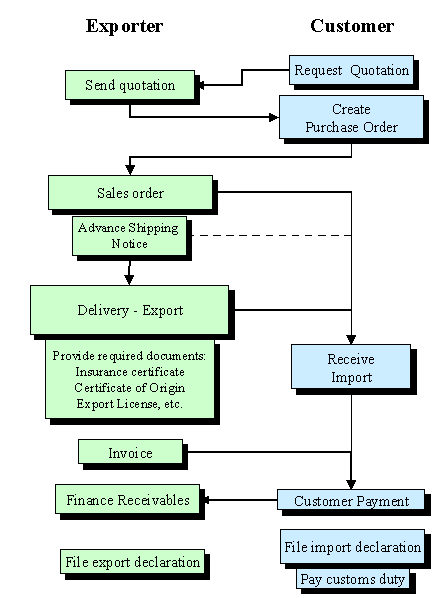
With the exception of the insurance certificates, you can create the above documents using the SAP Foreign Trade (FT) application.
Document Requirements
Certificate of Origin:
The certificate of origin is an official declaration, which certifies the country in which a commodity originated or was manufactured. In most cases, the importer and exporter must keep this document on file and provide it to the government only if requested.Shipper's Export Declaration (SED): In the USA, the SED is only required for shipments valued at more than US$ 2500 (formal entry). If you are shipping goods out of the USA, the SED does not go to the importer. You must send it to the US Government before the shipment leaves the US. With the Automated Export System (AES), you can file this document electronically.
Export vessel movement summary sheet: If you export by ocean from the USA, you must file this document with the Customs Service.
See also:
 US Customs: Automated Export System (AES)