If continuous compounding zero interpolation is active, you can extrapolate the yield curve after the last grid point in four different ways:
- Equal to yield category
: For the yield category par rate, the par rate of the last yield curve grid point remains constant. The system uses the procedure described under ‘constant par rate.’ For the yield category zero rate, the continuous zero rate of the last yield curve grid point remains constant. This corresponds to the option ‘zero rate constant’.
- Constant par rate
: The par rate (in the interest calculation method of the yield curve) of the last yield curve grid point remains ‘constant’. The yield curve is constructed from two parts:
- The original yield curve is used up until the last grid point.
- A flat yield curve, which is valid on the due date of the last grid point and for which the par rate = the zero rate = the par rate of the last yield curve grid point, is linked to the original yield curve.
In order to keep the calculation time for the determination of zero bond rates and discounting factors as short as possible, the system uses the following procedure:
- The system reads the par rate for the last yield curve grid point.
- The system constructs 4 additional annual grid points after the last yield curve grid point (internal only).
- The system adds a flat yield curve after the last yield curve grid point, meaning the system calculates the zero bond discounting factor (ZBDF) between the last yield curve grid point and the construed due date equal to the last yield curve grid point + 4 years
.
where
P: Par rate on the last yield curve grid point
dI: Number of interest days in the interest calculation method of the yield curve in year i after the last yield curve grid point.
bi: Number of annual base days in the interest calculation method of the yield curve in year i after the last yield curve grid point.
- In this way interest is calculated for an amount , which is created on the due date of the last yield curve grid point. The interest is calculated by multiplying this amount by the factor
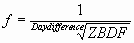 daily. The day difference is the number of actual days between the last yield curve grid point and the date that lies 4 years in the future. Factor f is calculated only once. The system then always uses this factor for the following calculation steps.
- The zero bond discounting factor (ZBDF), between the yield curve due date and a date that lies after the last yield curve grid point, is calculated using
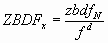 where
where
ZBDFN: zero bond discounting factor on the last yield curve grid point
f: the factor calculated above
d: the number of actual days between the due date of the last yield curve grid point and the required date.
- The system determines the continuous zero rate zcc using

where
dx: the number of actual days between the validity date of the yield curve and the required date.
- Constant zero rate
: the continuous zero rate of the last yield curve grid point remains constant.
- Constant continuous forward rate
: The continuous forward rate of the last yield curve grid point remains constant. The continuous forward rate at time point t is the interest rate received for the time period between  and
and  whereby
  becomes smaller and smaller. For the boarder-line case
  the continuous forward rate
 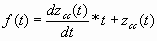 is calculated from the function of the continuous zero rate
. The continuous zero rate is calculated after the last grid point as follows (time specification t
x in ACT/365):
- Determination of the slop
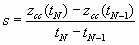 of the interpolation line between the penultimate and the last yield curve grid point.
- Calculation of the continuous forward rate on the last yield curve grid point:
 .
.  is calculated and used for all subsequent calculations of the zero rate.
- Calculation of the continuous zero rate using

.

 Extrapolation Methods when Continuous Compounding is Active