

 Networks in a Company
This example of a network for a company illustrates how constraints are used and how they work. This example shows how you can use constraints to do configuration tasks over several levels, inferring values for a subordinate configurable material by configuring the superior configurable material.

This example is not intended to provide any kind of technical information for setting up a network. The only purpose of this example is to illustrate the use of constraints.
Concept
A company network consists of different LAN types, operating systems, cables, and motherboards with different processors. Not all of these objects can be combined with each other. You can use object dependencies to model the interdependencies between these objects.
A LAN consists of cables, a server, and workstations. A workstation and a server contain a motherboard, an operating system, and a network card. If the LAN has a subordinate network, this network has its own server. You can use object dependencies to describe these interdependencies.
Structure
The following graphic shows the structure of the network in this example:
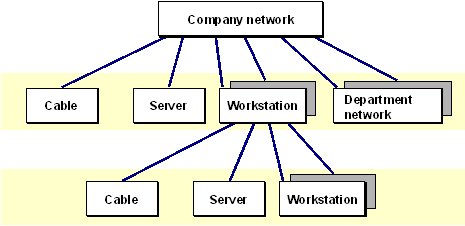
The servers, the company network, the workstations, and the department network are all configurable materials:
Material Number |
Description |
|
C-1040 |
Company network |
|
C-1041 |
Department network |
|
C-1042 |
Workstation |
|
C-1043 |
Server |
Workstations and department networks occur twice in the BOM of the company network. However, since the department network is a self-sufficient network, you can also sell this component on its own. For this reason, you need a separate configuration profile for the department network.
A configuration profile links the company network to class 300 COMPANY_NETWORK, and the department network to class 300 DEPT_NETWORK. These two classes are assigned to superior class 300 C_NET. The characteristics of class C_NET are inherited by the two subordinate classes, which have no characteristics of their own.

Servers are assigned to class 300 C_SERVER via the configuration profile, and workstations are assigned to class 300 C_WORKSTATION.
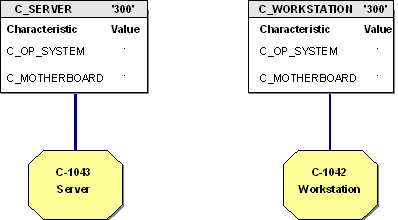
The classes have the following characteristics:
C_NET
Characteristic |
Value |
C_LAN_TYPE |
Ethernet Thinwire |
|
Ethernet Thickwire | |
|
Token Ring | |
|
Token Bus | |
|
FDDI | |
Characteristic |
Value |
C_CABLE_TYPE |
Twisted pair |
|
Shielded twisted pair | |
|
Coax cable | |
|
Glass fiber |
C_SERVER and C_WORKSTATION
Characteristic |
Value |
C_OP_SYSTEM |
OS1 |
|
OS2 | |
|
OS3 | |
Characteristic |
Value |
C_MOTHERBOARD |
486 SX |
|
486 DX | |
|
Pentium | |
|
68020 | |
|
68030 | |
|
68040 | |
|
Sparc |
Interdependencies
The following interdependencies are to be described by using constraints: