

 Creation of a Wf-XML Document
Use
The data exchange with other systems is performed with an XML document with the WebFlow function. The workflow system can automatically generate an XML document for the data to be transferred, Here, the following transfer formats are supported:
The operation
Features
The following Wf-XML documents are created automatically:
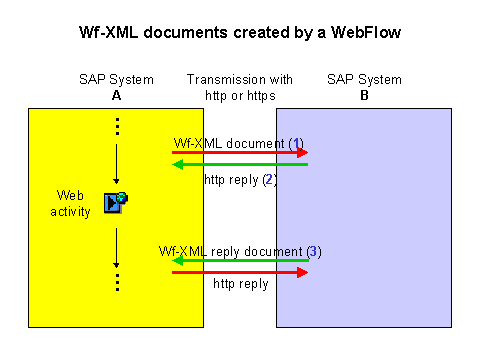
Wf-XML document (1)
The import parameters from the task container are used in creation. These are derived from the
interface of the reference workflow of the Web activity.The import parameter data of the task container is written into the Wf-XML document. The following content is transferred depending on the
data type reference:|
Data type reference |
Content transferred |
|
ABAP Dictionary |
All data |
|
Object reference to XML_DOC |
XML document that is referred to is triggered and completely transferred |
|
Other object reference |
Not supported |

Multiline import parameters are not supported.
Within the Wf-XML document the data from a container element is stored in separate areas denoted using <container_element_ID> data </container_element_ID>. The assignment of the data to the individual areas is made on the basis of name parity. When an SAP System receives a Wf-XML document that is to start or continue a workflow, the data from the individual sections of the Wf-XML document is assigned to container elements in the workflow container on the basis of name parity as well. For an example of a generated Wf-XML document (1), refer to number 1 in Examples of Created Wf-XML Documents.
If the indicator Wait for feedback is set within the Web activity, the URL to which the Wf-XML response document (3) from system B is to be sent is written into the Wf-XML document (1) under <ObserverKey>. This ensures that the Wf-XML response document (3) can be evaluated by the Web activity. The Web server must be defined for the URL to be created.
http reply (2)
If SAP System B receives a Wf-XML document, it sends an http reply (2) in the form of an XML document. This confirms the start of the workflow. For an example of an http reply (2), refer to number 2
Examples of Created Wf-XML Documents.Wf-XML response document (3)
The SAP system B sends a Wf-XML response document (3) when the workflow is complete. The export parameters of the workflow are written in the relevant areas of the Wf-XML response document (3) as with the import parameters when the call is made. For an example of a generated Wf-XML response document (3), refer to number 3
Examples of Created Wf-XML Documents. This happens regardless of whether or not SAP system A has evaluated this Wf-XML response document.Additional Wf-XML documents
If version 1.0 or above is used as the transfer format, then SAP system A can still influence workflow B after the end of the initial Web activity. The Wf-XML documents needed are created automatically by the WebFlow function.
If Wf-XML with version 1.1 and higher is used as the transfer format, both SAP system A and SAP system B can send notifications with data to the relevant partner.
Activities
The system creates the Wf-XML document automatically if you choose a Wf-XML transfer format in the Web activity. You will find the XML documents created in the work item display of the
Web work item.If a Wf-XML document was to start a workflow in your system but this has failed, you can find and display the Wf-XML document using the report
Displaying XML Documents.