Example: Parallel Availability Control Checks
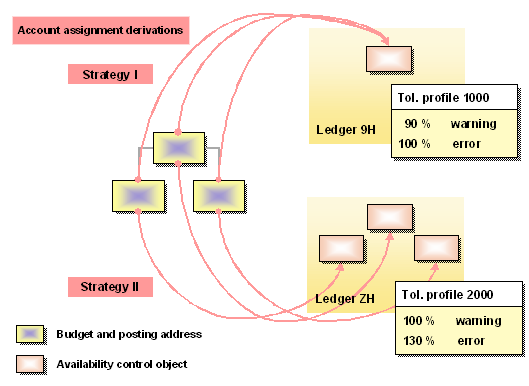
The following example illustrates how you can carry out parallel availability control checks using a number of ledgers. You can assign an individual tolerance profile and strategy for account assignment derivation of availability control objects to each ledger.
In this case, it is required that the total available budget of an organization should be checked at two levels up to a maximum of 100% usage level. If this tolerance limit is reached, additional postings are prevented by an error message. A warning message should be issued of the usage level reaches 90%. In this example, all budget addresses are summarized in a control object in derivation strategy I. The total budget distributed for all three account assignments is checked in a control object. It is not important what the usage level of an individual budget address is as only the total of all account assignments is checked.
This does not apply to the individual departments that are represented in this example by the three budget addresses. In individual cases it should be possible for the system to prevent additional postings when a usage level of 130% is reached. A warning message is issued when a usage level of 100% is reached. This occurs in strategy II of the following example where there is a corresponding control object for each budget address (this strategy corresponds to the strategy in the standard system).
Note that in the example above the assignments of posting addresses to budget addresses are not included in order to simplify the procedure. The FM account assignments used are posting addresses and budget addresses. You can find more information on the derivation strategy for budget addresses in the section Budget Structure Plan in BCS under
Derivation of Budget Addresses.