

 Capital Amounts
Definition
Capital amounts characterize a contract as at a certain calculation key date.
The system differentiates between contract-based capital amounts, flow-based capital amounts and derived capital amounts. Contract-based capital amounts result from the conditions and the loan data. Flow-based capital amounts are calculated using the flows. Derived capital amounts result when you total flow-based and contract-based capital amounts or calculate the difference between them.
Use
You can display the capital amounts in the basic data on the tab page Basic Data by choosing Change Contract or Display Contract. You can add other capital amounts using the pushbutton Capital Amounts. You can also reach this button via the functions Display Cash Flow or Calculate Cash Flow.
Calculating the capital amounts:

Protected Flows are planned records with due dates falling inside the fixed period before rollover.
Evaluation can be carried out after the due date or after the posting date.
Structure
Contract-based capital amounts
The contract capital is the commitment capital originally agreed on with the borrower for the entire term of the loan.
The current contract capital is the contract capital after all capital reductions and capital increases have been taken into account.
The commitment capital is the loan amount that the lender has agreed to lend for a fixed interest period. The commitment capital is the sum of the disbursement obligation and the remaining capital at the beginning of the fixed interest period.
The current commitment capital on a key date is the capital committed in the disbursement obligation and the remaining capital. At the beginning of a term the current commitment capital is equal to the contract capital. At the beginning of a fixed interest period the current commitment capital is equal to the commitment capital.
This is the sum of all capital reductions minus the sum of all capital increases in the current fixed interest period up until a key date.
Flow-based capital amounts
The value-dated capital on a key date, is the amount that the loan partner actually receives. It is basically the sum of all disbursements and capital transfers (inflows).
The value-dated capital in the local currency is calculated from the local currency amounts of the current flows.
|
Capital |
Flows |
||
|
+ |
Disbursements |
||
|
+ |
Capital transfers (inflow) |
||
|
- |
Rolling repayments |
This is the sum of the capital transfer outflows and the unscheduled repayments up to a key date. An unscheduled repayment can be generated from the conditions or entered manually using an application function For borrower’s note loans, the respective price gains/losses and the premium/discount accruals/deferrals proportionate to the capital are included in the calculation, in addition to the unscheduled repayments.
This is the sum of the capital transfer outflows and the incoming payments resulting from the unscheduled repayments up to a key date. For borrower’s note loans, the respective price gains/losses and the premium/discount accruals/deferrals proportionate to the capital are included in the calculation, in addition to the unscheduled repayments.
This is the sum of the condition-based, scheduled repayments up to a key date. This can include installment repayments, annuities and final repayments.
This is the sum of the incoming payments from condition-based, scheduled repayments up to a key date.
Derived capital amounts
The disbursement obligation on a key date in the amount that can still be disbursed or transferred from another contract. It is basically the difference between the current contract capital and the value-dated capital.
|
Capital |
Flows |
||
|
+ |
Current contract capital |
||
|
- |
Value-dated capital |
||
|
+/- |
Euro correction for the disbursement commitment |
The remaining capital on a key date is the balance of the balance sheet account. It is basically the difference between the value-dated capital and the sum of all resulting repayments and capital transfer outflows. In the case of interest capitalization, the interest is also included in the calculation. The difference between remaining capital and nominal remaining capital is that premiums/discounts that have not yet been accrued/deferred are taken into account for borrower’s notes that are posted net. This is because the premium/discount is managed in the position and not in the accruals/deferrals account.
The remaining capital in local currency is calculated from the local currency amounts of the respective flows and also includes exchange rate gains and losses.
|
Capital |
Flows |
||
|
Value-dated capital |
|||
|
- |
Capital transfers (outflow) |
||
|
- |
Condition-based repayments |
||
|
- |
Unscheduled repayments |
||
|
+ |
Capitalized interest |
||
|
-/+ |
Premium/discount that has not yet been accrued/deferred for borrower’s note loans posted net |
||
|
+/- |
Euro correction for the remaining capital |
The nominal remaining capital on a key date is the amount that the loans partner still has to repay. It is basically the difference between the value-dated capital and the sum of all resulting repayments and capital transfer outflows. In the case of interest capitalization, the interest is also included in the calculation.
|
Capital |
Flows |
||
|
Value-dated capital |
|||
|
- |
Capital transfers (outflow) |
||
|
- |
Condition-based repayments |
||
|
- |
Unscheduled repayments |
||
|
+ |
Capitalized interest |
||
|
+/- |
Euro correction for the remaining capital |
The effective capital on a key date corresponds to the remaining capital but takes into account the incoming payments resulting from repayments, and not the debit positions.
The effective capital in local currency is calculated from the local currency amounts of the respective flows and also includes exchange rate gains and losses.
For loans taken the effective capital is equal to the remaining capital.
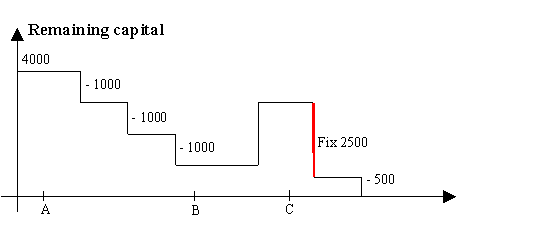
The available disbursement obligation on a key date is the maximum amount that can be disbursed or posted on a key date. This amount is calculated from the disbursement obligation on a key date and also takes into account all changes in capital (reductions and increases) and all fixed or protected flows lying after the key date. These include in particular:

Example for available disbursement obligations
- Loan given
- Contract capital: 4 000 Euro
- Start of term: 01.01.2000
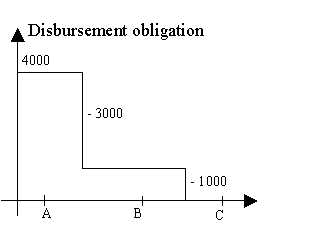
1. Disbursement: 3 000 Euro
2nd capital reduction: 1 000
At points in time A, B or C, the following amounts are the maximal amounts that can be disbursed:
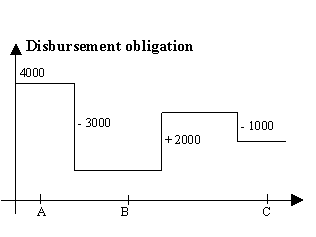
1. Disbursement: 3 000
2nd capital increase: 2 000
3rd disbursement: 1 000
At points in time A, B or C, the following amounts are the maximal amounts that can be disbursed:
The available capital on a key date is the maximum amount that can be repaid or transfer posted for a loan on a key date. This amount is calculated from the nominal remaining capital on a key date and also takes into account all fixed or protected flows lying after the key date. These include in particular:
Example for available capital:
- Loans given
- Contract capital: 6 000 Euro
- Start of term: 01.01.2000
- Installment repayments: 1 000 Euro
- 1st disbursement: 4 000 Euro
1. Example without fixed flows
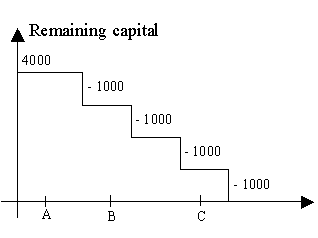
At points in time A, B or C, the following amounts are the maximal amounts (available capital) that can be repaid:
If an unscheduled payment amounts to the available capital at points in time A, B or C, the subsequent condition-based repayments do not apply.
2. Example with fixed flows
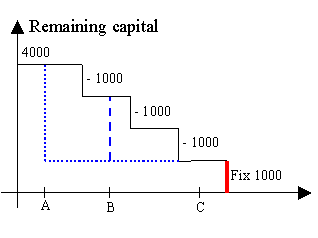
At points in time A, B or C, the following amounts are the maximal amounts (available capital) that can be repaid:
If an unscheduled payment amounts to the available capital at point A or B, the rate of the subsequent condition-based repayments must be changed to 0 otherwise the fixed repayment leads to an overpayment at the end of the cash flow.
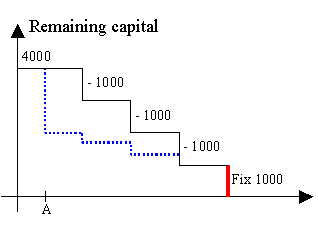
An unscheduled repayment of 2 000 Euro at point A can only result if the rate of the subsequent repayments has be adjusted accordingly. If this is not done, the fixed repayment leads to an overpayment at the end of the cash flow.
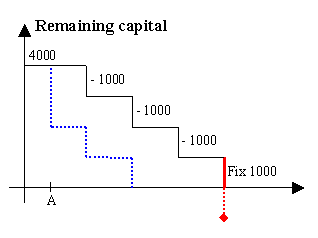
3. Example with several disbursements
At points in time A, B or C, the following amounts are the maximal amounts (available capital) that can be repaid:
01.
At points in time A, B or C, the following amounts are the maximal amounts (available capital) that can be repaid:
Example for capital amounts
For purposes of simplification, interest is not included.
1. Mortgage loans
- Loans taken
- Contract capital: 100 000 Euro
- Start of term: 01.11.1999
- 1st fixed period: 01.11.1999 – 31.12.1999
- 2nd fixed period: 01.01.2000 – 31.03.2000
a) Loans with installment repayments
Cash Flow
|
Date |
Amount |
Contract/ Conditions |
Flow |
|
11.03.1999 |
60 000 |
Disbursement |
|
|
11.30.1999 |
5 000 |
Installment repayment |
|
|
12.02.1999 |
5 000 |
Installment repayment IP |
|
|
12.15.1999 |
30 000 |
Capital transfer (incoming) |
|
|
12.31.1999 |
5 000 |
Installment repayment |
|
|
12.31.1999 |
5 000 |
Installment repayment IP |
|
|
Rollover |
|||
|
01.14.2000 |
15 000 |
Unscheduled Repayment |
|
|
01.14.2000 |
10 000 |
Partial waiver |
|
|
01.17.2000 |
15 000 |
Unscheduled repayment IP |
|
|
01.31.2000 |
5 000 |
Installment repayment |
|
|
01.31.2000 |
5 000 |
Installment repayment IP |
|
Capital amounts on a particular key date
|
Date |
Current contract capital |
Commitment capital |
Disbursement commitment |
Value-dated capital |
Remaining capital |
Effective capital |
|
11.01.1999 |
100 000 |
100 000 |
100 000 |
0 |
0 |
0 |
|
11.03.1999 |
40 000 |
60 000 |
60 000 |
60 000 |
||
|
11.30.1999 |
55 000 |
|||||
|
12.02.1999 |
55 000 |
|||||
|
12.15.1999 |
10 000 |
90 000 |
85 000 |
85 000 |
||
|
12.31.1999 |
80 000 |
80 000 |
||||
|
Rollover |
||||||
|
01.01.2000 |
100 000 |
90 000 |
10 000 |
90 000 |
80 000 |
80 000 |
|
01.14.2000 |
90 000 |
0 |
65 000 |
|||
|
01.17.2000 |
65 000 |
|||||
|
01.31.2000 |
60 000 |
60 000 |
||||
b) Foreign currency loans with installment repayment
Cash Flow
|
Date |
Amount |
Flow |
Local currency |
Exchange rate |
|
11.03.1999 |
60 000.00 |
Disbursement |
36 000.00 |
0.60 |
|
11.30.1999 |
10 000.00 |
Installment repayment |
5 000.00 |
0.50 |
|
11.30.1999 |
0.00 |
Exchange rate loss |
1 000.00 |
|
|
12.01.1999 |
30 000.00 |
Disbursement |
15 000.00 |
0.50 |
|
12.31.1999 |
10 000.00 |
Installment repayment |
6 500.00 |
0.65 |
|
12.31.1999 |
0.00 |
Exchange rate gain |
875.00 |
Capital amounts on a particular key date
|
Date |
Value-dated capital in contract currency |
Value-dated capital in local currency |
Remaining capital in contract currency |
Remaining capital in local currency |
|
11.01.1999 |
0 |
0 |
0 |
0 |
|
11.03.1999 |
60 000 |
36 000 |
60 000 |
36 000 |
|
11.30.1999 |
50 000 |
30 000 |
||
|
12.01.1999 |
90 000 |
51 000 |
80 000 |
45 000 |
|
12.31.1999 |
70 000 |
39 375 |
2. Borrower's note loans
- Contract capital: 100.000
- Disbursement rate 98%
- Posting system: net
- Term: 01.01.2000 – 31.12.2000
Cash Flow
|
Date |
Settlement amount |
Nominal amount |
Flow |
|
01.17.2000 |
60 000.00 |
60 000.00 |
Purchase order |
|
01.17.2000 |
1 200.00 |
1 200.00 |
Discount |
|
01.17.2000 |
1 200.00 |
1 200.00 |
Discount withholding |
|
04.28.2000 |
20 400.00 |
20 000.00 |
Unscheduled Repayment |
|
04.28.2000 |
400.00 |
Realized price gains |
|
|
04.28.2000 |
282.56 |
Clear discount proportional to capital |
|
|
04.28.2000 |
352.33 |
Clear discount proportional to time |
|
|
12.31.2000 |
60 000.00 |
60 000.00 |
Final repayment |
|
12.31.2000 |
565.11 |
Clear discount proportional to time |
Capital amounts on a particular key date
|
Date |
Disbursement commitment |
Value-dated capital in contract currency |
Remaining capital |
Nominal remaining capital |
Unscheduled repayment |
Scheduled repayment |
|
01.01.2000 |
100 000.00 |
0 |
0 |
0 |
0 |
0 |
|
01.17.2000 |
40 000.00 |
60 000.00 |
58 800.00 |
60 000.00 |
||
|
04.28.2000 |
39 434.89 |
40 000.00 |
19717.44 |
|||
|
12.31.2000 |
0.00 |
0.00 |
40 000 |