

 Volatilities
Definition
Volatilities describe as a risk measure the fluctuation range of a price parameter during a certain time period and, consequently, both the positive and negative deviation of market parameters from their expected value.
We make a distinction for calculation between historical and implicit volatilities:
Historical volatilities are determined on the basis of data from the past. Sample standard deviation is used as a reliable estimation function for the volatility. If you have daily volatilities, you can convert these to annual values as follows:
 Implicit volatilities
It is frequently not the historical volatility that is measured, but the volatility resulting from an option price. This implicit volatility is an estimation of the market on the volatility of the market parameter. This comprises both historical information and also market expectations regarding the future.
Use and origin
You can use historical volatilities both for the value at risk approach and also for the option price calculator. In the R/3 system, implicit volatilities are only used in the option price calculators.
Before you can use volatilities for value at risk, they need to be linked to a statistic type in Customizing.
Historical volatilities and implicit volatilities are usually transferred to the system from external sources. Additionally, you have the option of calculating historical volatilities directly in the R/3 system by means of the statistic calculator. Since calculation using the statistic calculator involves scaling with the confidence factor of the statistic type, it is advisable to only use such volatilities for the value at risk approach.
Structure
The clear and unmistakable determination of the volatilities in the volatility table is different, depending on the market parameter on which they are based. The following information must be stored in the volatility table:
Volatility |
Required parameters for clear and unmistakable definition |
Interest volatility |
Volatility type, reference interest rate, date, term |
Exchange rate volatility |
Volatility type, currencies, date, term |
Security volatility |
Volatility type, class, date, term |
Index volatility |
Volatility type, index, date, term |

In the statistic calculator, volatilities for interest are usually calculated based on zero coupon rates to ensure consistency with the net present value calculation with zero coupon rates. If you wish to determine volatilities for the variance/co-variance approach in value at risk evaluation from par coupon curves, you will need the interest rate volatility curve in addition to the definition of an interest volatility, which defines an assignment of the interest volatility to an interest rate structure curve. Using this assignment, the par rates can be calculated into corresponding zero rates and from these, the volatilities.
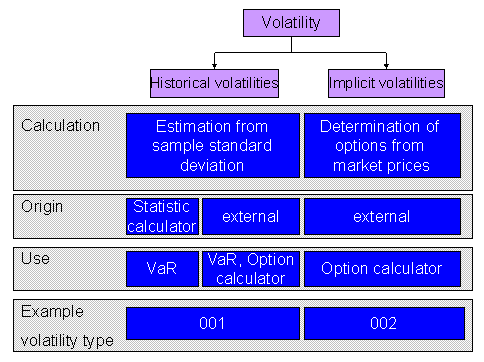
The following examples of volatility types serve to clarify the definition in the system:
Volatility type |
Volatility description |
Volatility rate category |
Single / average volatility |
Statistic type |
002 |
Forex volatility |
Average |
||
001 |
Risk metrics |
2 |