

 Using Logs
Top Level Information
The first line of the log displays the log identification number and the transaction from which the tests were started. Depending on the tests, other information is also displayed:
This example shows that six test configurations were started from the Test Organizer:

This example shows that test script MHP_COMMENT was started from eCATT:

Directly under the  is the following information:

Maintenance System
If a test script has a maintenance system, the RFC destination is displayed beside a  , and the component information is underneath.
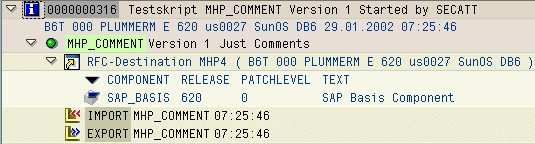
RFC destinations
An RFC destination, for a target system assigned to a command, is displayed beside a .

Comments
You can display the comments from test scripts in the log. To do this, choose  and, in the dialog box that follows, select Display Comments.

Errors
An error is marked by a  .
.
If a script contains one or more errors, it is marked by a .
If a node is marked as containing an error, the node above it in the hierarchy is marked as containing an error.

The following log shows a test configuration containing two variants. One has at least one error and the other has no errors.

IF...ENDIF Structures
If a condition is true, it is marked by a  .
.
If a condition is false, it is marked by a  .
.
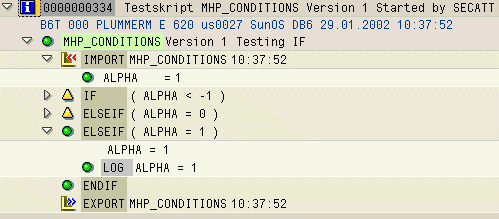
A condition that is false is not an error.
Viewing XML Data
XML data is generated when testing function modules and transactions. To view XML data, click the name of the XML data in the log.

Here is an extract of XML-DATA-01 from the log shown above.

Messages
All the messages issued by a transaction are displayed in the log. You can also see the messages in the XML data.

You can display the long text of a message by clicking the message in the log.
Navigating to eCATT Objects
You can display an eCATT object, in its editor, by clicking it in the log. For example, by clicking on the colored areas in the log below, you could go to the configuration editor, system data editor, or the test script editor.
Navigating to the Spool Display
When a recorded transaction uses a print function that sends a document to the spool, a message is recorded in the log. By clicking the message, you can jump to the display of the spool request. To enable this, you need to maintain the Customizing table ECLOG_SPOC with the message ID, message number, and which variable part of the message contains the spool request number.

In the above example, you would have created an entry in the table with
SY, 374, and 1.