
 OTB: Example Calculations for a Season
Planning Phase for Early Spring 1999
In September 1998 you begin planning for the Early Spring 1999 season. You plan to build up January’s stock in anticipation of the stock needed February, which is the start of the season. You also determine the planned revenue and month-end closing stock for the months February through April. The stock initializer specifies an opening stock of $100 for the planning horizon (January to April). In this phase, the OTB is determined by the following formula:
Pln. sales - Pln. opening stock + Pln. ending stock = OTB
For example:
January: $0 - $100 + $600 = $500
February: $1700 - $600 + $900 = $2000
Purchasing Phase
In November you make the first purchases. OTB is calculated as the difference between the planned purchasing budget and open purchase orders.
Pln. sales - Pln. opening stock + Pln. ending stock - Open POs = OTB
For example:
January: $0 - $100 + $600 - $500 = $0
February: $1700 - $600 + $900 - $1700 = $300

Beginning of the Business Phase
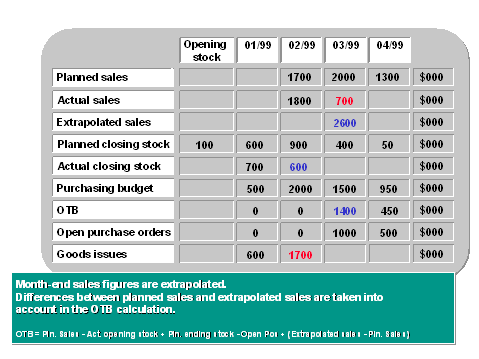
The first merchandise receipts occur in January 1999. The system takes into account any differences between planned and actual data. Here, the actual opening stock in February is greater than planned due to an overdelivery in January. February’s OTB is corrected accordingly.
Pln. sales - Actual opening stock + Pln. ending stock - Open POs = OTB
For example:
February: $1700 - $700 + $900 - $1700 = $200
Remember that the actual opening stock of any month is the same as the closing stock of the previous month.

During the Business Phase
During the course of any month, the month-end sales volume is extrapolated from the actual data to that point. Differences between planned sales and extrapolated sales are taken into account in calculating OTB:
Pln. sales - Actual opening stock + Pln. ending stock
- Open POs
+ (Extrapolated sales - Pln. sales) = OTB
For example:
March: $2000 - $600 + $400 - $1000 + ($2600 - $2000) = $1400
A User Exit is available for you to define your own formula for calculating extrapolated sales.