Start - Finish Rule
Start - Finish Rule
Use
Use the start - finish rule when you want a quick and easy measurement technique to get an initial rough picture of project progress. This measuring technique is based on scheduling. The work package duration for this technique should be more than three months.
Prerequisite
For the start-finish rule, the start and finish dates are maintained in the objects, as follows:
You maintain planned dates in time scheduling, the project planning board, or structure planning.
You can either enter the actual dates yourself manually, or have the system determine them using completion confirmations.
See
 Entering Actual Dates
Features
When you use the start-finish rule, the percentage of completion at the start is increased from 0% to an initial value which you have maintained in Customizing for measurement methods. When your project is finished, the POC is 100%. In
progress version customizing, you stipulate which set of dates the system should use to determine the POC:The system we deliver as standard contains the following methods for the start-finish rule:
The initial POC is 0 %. The start date for the work package is irrelevant for progress analysis. The work package does not attain a POC of 100% until the work package is finished.
Use the 0 - 100 method for work packages which fall within in a certain reporting period, for example, within one month.
The initial POC is 20 %. In this case, an initial POC of 20% is assumed at the start of the work package. Once the work package is finished, the POC increases by 80% to 100%.
At first, this assumption of a 20% POC may seem too optimistic. However, during execution of the project the POC remains at 20% even for work packages which are almost finished, which gives you a realistic estimate overall.
You should only use this method if no more accurate estimates are available and the work package lasts for no more than three months.
Example
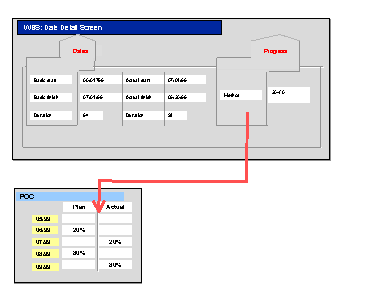
The graphic below shows how the system uses the 20-80 method to determine the POC on a schedule-related basis.