 Available Capacity
Available Capacity
Definition
The actual usable working time of a capacity in production. If the capacity consists of several individual capacities, the actual usable working time of an individual capacity is multiplied by the number of individual capacities. You can use a conversion factor to express an available capacity in a different unit (for example, tons). See also:
Converting the Base Unit of Measurement.The actual usable working time in production is also called operating time in the R/3 System.
Use
Available capacities are used in scheduling and capacity requirements planning.
Structure
You always enter an available capacity that refers to a day or a shift.
Enter the following:
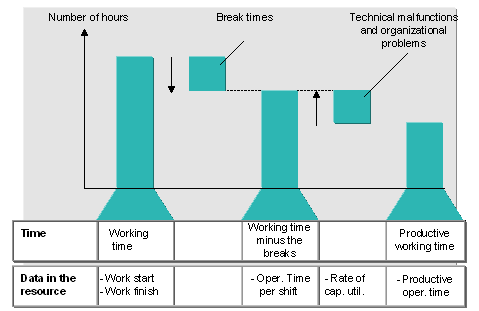
This is the actual time the work starts and finishes.
The time that is used for breaks during the working time.
The working time remaining after breaks have been subtracted can only be used to a certain percentage rate (for example, due to organizational problems). This percentage rate is called rate of capacity utilization.
The system uses the following formula to calculate the operating time:
Operating Time = (Working Time - Break Times) x Rate of Capacity Utilization / 100%
The following formula is used to calculate available capacity:
Available Capacity = Operating Time x Number of Individual Capacities
The following graphic illustrates these relationships:
Standard Available Capacity
In the simplest case, you enter the standard available capacity as the available capacity. The validity period of the standard available capacity is unlimited, which means the same capacity is offered on each workday of the factory calendar.
Version of Available Capacity
If a standard available capacity does not meet your requirements, you create a version of available capacity and activate it. It then represents the available capacity (instead of the standard available capacity) for scheduling and capacity requirements planning.