Special Features
InfoSets using logical datasets and InfoSets without underlying datsets have largely the same structure. Differences only occur if the situation absolutely demands it. A logical database is a hierarchical structure of tables, whereas an InfoSet without an underlying database is based on a single (sequential) table. You can think of an InfoSet without an underlying database as a special kind of InfoSet which uses a logical database consisting of a single table.
The facilities and options available for creating both types of InfoSet are also the same, apart from the structure of the data to be processed. They include:
The facilities for InfoSets without an underlying database are simpler as a result of the simpler structure of the data to be processed. This applies to:
Additional fields do not need to be assigned to a particular table. However, the sequence you specify is important because it allows you to control the flow. The code lines for an additional field should appear in the section of a generated query report used to process each data record (table entry) read.
Additional tables are not assigned to a particular table either. The sequence is just as important as it is with additional fields.
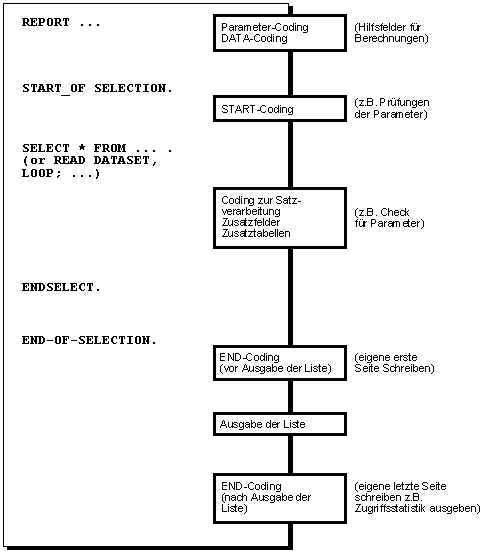
Since the events GET and GET LATE are closely associated with logical database tables, they do not occur at all in query reports for InfoSets without an underlying database. Instead, there is record processing code. This is inserted in generated query reports at the point (event) where loop processing of data records (table entries) usually takes place. The position it occupies depends on the sequence you specify. There is no equivalent to the GET LATE code, since no data hierarchy exists in this case.
The diagram below shows the sequence of sections of code you can modify in a query report for an InfoSet without an underlying database.