Management of Retained Earnings and Annual Net Income
Depending on which type of appropriation of retained earnings is used, the balance sheet and income statement are linked to each other by two value-based, identical FS items, namely "Retained earnings" (for appropriations at the end of the income statement) or "Annual net income" (for appropriations on the balance sheet).
Consequently, to prevent inconsistencies, the elimination or reclassification of minority interest in the retained earnings or the annual net income on the balance sheet must be reconstructed within the appropriation of retained earnings. The system automatically creates the necessary postings.
The required actions depend on how the appropriation of retained earnings is stated. See also
Retained Earnings in the FS Chart of Accounts.Management of retained earnings when stating appropriations at the end of the income statement
When stating appropriations in this way, retained earnings must be entered as a selected item with classification key BG (balance sheet item) or ERG (income statement item). Instead of waiting until Customizing consolidation of investments, this is done in the Implementation Guide under Master data
(r) Financial Statement Items ® Maintain selected items. The system also requires the following selected items within the appropriation of retained earnings for treating retained earnings:This item is entered under the classification key JVE in the Implementation Guide under Consolidation
The portion of the single company’s annual net income that (a) resulted prior to the period of first consolidation, and (b) is not disclosed as the group annual net income, is posted to this item.
This item is entered under the classification key BIL in the Implementation Guide under Consolidation ® Consolidation of Investments ® Maintain selected items.
The FS item, possibly differentiated by debits/credits, is stored in the Minority interest detail screen. It is stored by the system under the key GVM.
The FS item is entered in the Differential detail screen. It is stored by the system under the key MIK.
When posting, an adjustment to net income results, which causes the change to the retained earnings in both the balance sheet and the income statement.
Actions taken by the system
Selected items with the classification keys BG, BIL, JVE, MIN and GVM
The user enters the changes to retained earnings in the Changes in Investee Equity table. (For information on entering reported data for the consolidation of investments see General Information on Table Maintenance.) When consolidation of investments takes place, the system interprets the entries in the table.
The entries are interpreted for the relevant item, the indicator for first or subsequent consolidation, and the year and period. In addition, the system refers to the year and period maintained in the company master record, and possibly in the subgroup master record. The system can post 5 different entries:
The system posts the amount to the carry-forward item specified with the key BIL. The group share is then eliminated, and minority interest reclassified to the minority interest item specified with the key MIN (balance sheet item).
This entry normally represents the annual net income accrued up to the period of first consolidation and which must be included in the first consolidation. The system clears the amount at the item defined under the key JVE. The group share is then eliminated, and minority interest reclassified to the minority interest item specified with the key MIN (balance sheet item).

The indicator is not important for first/subsequent consolidation in cases 1 and 2 because the entries must always be included in first consolidation. The system posts to different items, however.
– If there is at least one entry of the type in cases 1 or 2 parallel to this entry, posting takes place as in case 2. In other words, the system posts the amount to the item specified with the key JVE and reclassifies the minority interest.
– If there is no entry of the type in cases 1 or 2 parallel to this entry, posting takes place as in case 1.
The reason for this is that the system assumes that you have entered a cumulative amount that includes the retained earnings of the previous years. Therefore, the system uses the item specified as the carryforward item with key BIL.
The entry is treated as a subsequent consolidation posting. The system determines the minority interest in the retained earnings and posts this to the minority interest item specified with the key MIN (balance sheet item). The offsetting entry is posted to the relevant appropriation of retained earnings item for minority interest with the key GVM.
The entry is treated as a subsequent consolidation posting, as in case 4.
Specified item with the classification key MIK
Step acquisition reduces the minority interest on the balance sheet. If automatic adjustments to appropriation items is selected, a deduction from minority interest is posted (GVM). The clearing item (MIK) is the offsetting item.
If the transfer is related to a change in investment, the system proceeds as with a step acquisition.
Same as step acquisition
The adjustments to net income result in the proper disclosure of retained earnings.
Account representation
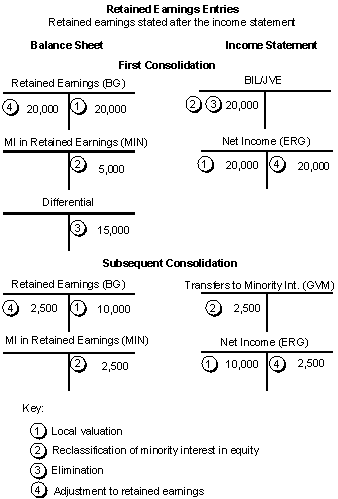
The following diagram demonstrates the handling of retained earnings for first and subsequent consolidation. The group share is 60 %.
Management of annual net income when showing appropriations on the balance sheet
When stating appropriations in this way, the annual net income must be entered as a selected item with classification key BG (balance sheet item) or ERG (income statement item). Instead of waiting until Customizing consolidation of investments, this is done in the Implementation Guide under Master data
® Financial Statement Items ® Maintain selected items. The retained earnings totals item is the result of the annual net income and the group’s appropriation items.The system also requires the following selected items for treating retained earnings:
This item is entered in the Minority interest detail screen under the key GVM.
This item is entered in the Implementation Guide in the section Individual Financial Statement Data as a selected item under the key JVE.
In the year of first consolidation, you should post the amount of annual net income which is accrued up to the period of first consolidation and which must be included in the first consolidation to the item "Annual net income prior to first consolidation" (balance sheet item). You should also post the amount of annual net income which is accrued after the date of first consolidation and which is to be included in subsequent consolidation.
Enter the item in the detail screen Differential with the key MIK.
Actions taken by system
Selected items with the classification keys BG, JVE, MIN and GVM.
The user enters the changes to retained earnings in the Changes in Investee Equity table. (For information on entering reported data for the consolidation of investments see
General Information on Table Maintenance.) When consolidation of investments takes place, the system interprets the entries in the table.The entries are interpreted for the relevant item, the indicator for first or subsequent consolidation, and the year and period. In addition, the system refers to the year and period maintained in the company master record, and possibly in the subgroup master record. The system can post 5 different entries:
The system posts the amount to the item to which where the annual net income for the previous years was transferred in a balance carry-forward procedure. (A precondition for this is that the annual net income item is maintained as a specifying and the carry-forward item as a selected item with the key VTR. See also
The group share is then eliminated, and minority interest reclassified to the minority interest item specified with the key MIN (balance sheet item).
The system clears the amount at the item defined under the key JVE. The group share is then eliminated, and minority interest reclassified to the minority interest item specified with the key MIN (balance sheet item).
The indicator is not important in cases 1 and 2 because the entries must always be included in first consolidation. The system posts to different items, however.
– If there is at least one entry of the type in cases 1 or 2 parallel to this entry, posting takes place as in case 2. In other words, the system posts the amount to the item specified with the key JVE and reclassifies the minority interest.
– If there is no entry of the type in cases 1 or 2 parallel to this entry, posting takes place as in case 1.
The reason for this is that the system assumes that the user has entered a cumulative amount which includes the annual net income of the previous years. Therefore, the system posts to the item specified as the carryforward item.
Since all appropriation of retained earnings items are balance sheet items, group shares and minority interest are eliminated and reclassifies within the balance sheet during for first consolidation without an adjustment to retained earnings.
The entry is treated as a subsequent consolidation posting. The system determines the minority interest. Minority interest is posted to the Minority Interest in Annual Net Income item in the balance sheet (MIN / credit entry) and to the Minority Interest in Annual Net Income item in the income statement (GVM / debit entry). Adjustments to retained earnings/annual net income correct the items Annual Net Income (BG) in the balance sheet and Annual Net Income (ERG) in the income statement.
The entry is treated as a subsequent consolidation posting, as in case 4.
Selected item with the classification key MIK
When a company is divested, retained earnings eliminations from previous periods, which do not affect net income, are reversed on the clearing item.
Account representation
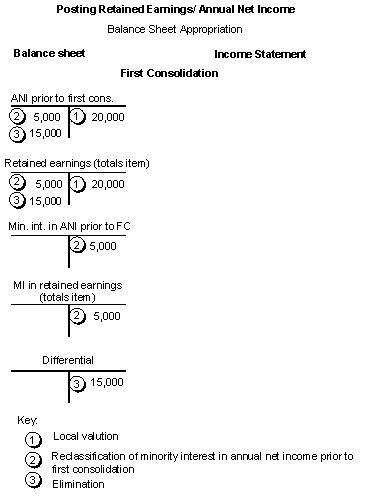
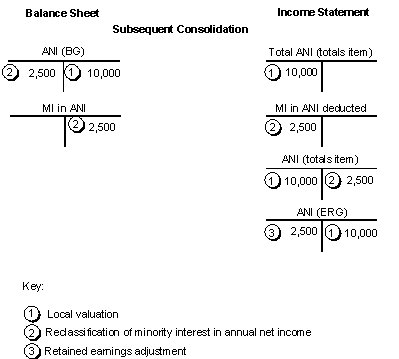
The following diagram demonstrates the handling of annual net income for first and subsequent consolidation. The group share is 60 %.