
Subgroups
Within the consolidation, companies are combined together into subgroups. The creation of subgroups has the following objectives:
The creation of a subgroup is fundamentally dependent upon whether a simultaneous consolidation or a step consolidation is to be performed.
Simultaneous consolidation
In a simultaneous consolidation, all the companies to be included in a group are taken into consideration in one activity. This means, for example, that the elimination of intercompany (IC) payables and receivables, the consolidation of IC revenue and expenses and the elimination of IC profit and loss for each company is reconciled with each other company in the consolidation with regard to partner relationships. When consolidating investments, any shares belonging to superior parent companies are included in the eliminations.
In the FI-LC system you need to create a subgroup for the group. This subgroup includes all of the companies. If, for reporting purposes, the consolidation is to be implemented for additional groups of companies, you will also need to create the appropriate subgroups.
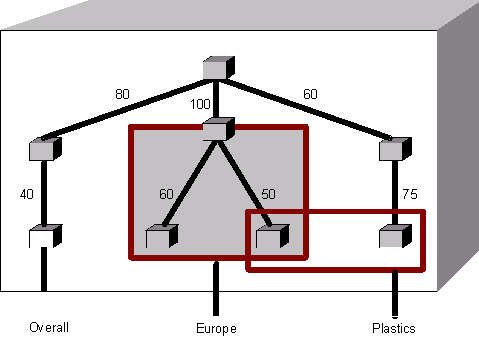
Arbitrary combination of subgroups as reporting entities
Step Consolidation
In a step consolidation, the individual companies are consolidated ‘step by step’ according to the hierarchy of a (multi-level) consolidation. A subgroup is created for each hierarchy level. First, the subgroups at the lowest level in the hierarchy are consolidated. The financial statements of these subgroups are then taken into account when the next highest hierarchy level is consolidated. The consolidation process continues in this ‘step-like’ fashion until all the companies are consolidated at the highest hierarchy level.
In the FI-LC system, the subgroup financial statements are transferred to the next level by creating rollup companies. The rollup company assumes the results of the subgroup financial statement and is used as an independent company at the next hierarchy level in the consolidation.
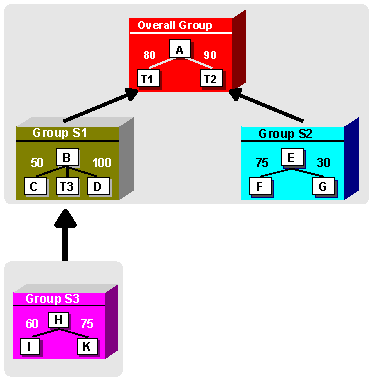
Subgroups in step consolidation

One condition for step consolidation in the FI-LC system is the portrayal of the hierarchy levels via subgroups which do not contain overlapping companies. This means that a company within a subgroup may not be included in another subgroup. If the subgroups overlap because you assigned them to various consolidations, you cannot execute the step consolidation in the system using automatic postings.
When defining a subgroup, please note that this can consist of either "normal" companies or rollup companies only. See also:
When executing a step consolidation in the FI-LC system, you need to make sure that the individual subgroup financial statements are created using the simultaneous consolidation process. Step consolidations are therefore processed exclusively using the "step by step" process of the consolidated group hierarchy.
For a fundamental comparison of both procedures see
The following sections explain how to implement a simultaneous consolidation. For a discussion on steps also to be considered in step consolidation see
Step Consolidation.