 Manual Cost Planning in the Work Breakdown Structure
Manual Cost Planning in the Work Breakdown Structure
Purpose
If cost planning and controlling are the most important factors in a project, then enter the expected costs, activities, and business processes in manual cost planning. You can use manual cost planning to compare planning and actual costs, and thus make a differentiated variance analysis.
Implementation Considerations
If you enter planning values on the lower planning elements, then the system totals values in an upward direction (bottom-up planning). Alternatively, you can manually distribute the planning values from the planning elements at the top to those below (top-down planning).
See also:
 Totaling Planning Values
Integration
You can manage the approved cost limit for a budget by using
Budget Management .The graphic below shows how cost planning and budgeting interact.

Features
There are different types of planning and functions, which cover the different levels of detail in the various phases of a project:
Integrated Planning
Integrated planning for projects enables you to settle planning data or business processes and to pass them on the profit center and the general ledger.
Integrated planning for projects corresponds to integrated planning for internal orders.
For more information, see
Integrated Planning for Internal Orders.Plan-Integrated Projects:
Plan-integrated projects enable you to plan cost elements and activity inputs integrated with cost centers and business processes in a plan version. The system updates allocations directly to the cost center or the business process.
Non-Plan-Integrated Projects:
You can only plan costs and activities locally on non-plan-integrated projects. There is no planning on the cost centers or business processes used.
Planning in More Than One Plan Version
Information on a project can change during the planning phase. Cost planning in more than one version is therefore useful. This corresponds to the planning process in normal business practice. You can plan projects in as many CO-versions as you wish.
See also
Plan Versions.Types of Planning
The work breakdown structure provides you with different planning types on the WBS element. This is independent of the project status and the level of detail required.
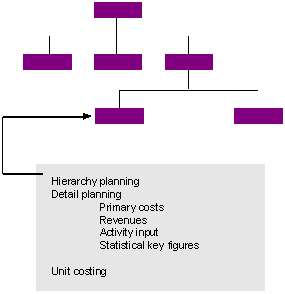
You can use these types of planning individually or together, so you can use unit costing or cost element planning for certain subtasks in a planning element for example, depending on the information that you have available. This enables you to estimate the costs of the remaining tasks using hierarchy planning.
Hierarchy Planning of Overall and Annual Values
Hierarchy planning is the simplest way of planning costs. This type of planning does not depend on cost elements. The planning values are entered and displayed in a hierarchy.

You can estimate the expected costs for a project or planning element by, for example:
Hierarchy planning on the work breakdown structure corresponds to overall planning for internal orders.
See also:
Overall Planning for Internal OrdersIf you have more information during planning, then hierarchy planning is a useful start for two alternative types of more detailed project cost planning.
Cost Element and Activity Input Planning (Detail Planning)This type of planning covers planning (by cost element) of primary costs, revenues, activity input and statistical key figures.
If you have accurate information on resources, quantities, and prices, you can use unit costing as a highly detailed planning method for planning project costs. You can execute unit costing on an overall and an annual basis.