 Repeating Groups
Repeating Groups
Use
Repeating groups iterate over data objects stored on the substance database. If a symbol refers to several data records, you can use the repeating group to control which data records are to be output.
Features
A repeating group carries two main items of information:
See also:
Repeating group type
|
Identification code for the object in thesymbol |
Characteristic of a characteristic category |
(M) |
Component of a characteristic |
(S:POS, S:POSD) |
User-defined text of characteristic |
(S:FREI) |
Usage of a characteristic |
(S:VERW) |
Transport data |
(S:CLASS) (see also Example: Repeating group S:CLASS |
|
(G) |
|
(D) |
|
(Q) |

A slave always references the data for a characteristic value. In order for the system to allocate the right characteristic category, a slave must nest in a master.
Identification code inthe symbol |
Description
|
n |
The system selects value "n" |
* |
The system selects all values it finds |
n-m |
The system selects all values from "n" to "m" |
n-* |
The system selects all values starting as of "n" |
The range is always separated from the other parameters of the symbol by a semicolon.

<11BRG001(M,SAP_EHS_1015_003;1-3)>
<01G1015003AD
(P;01)><11ERG001>
The system expands the first three characteristic records of characteristic category SAP_EHS_1015_003 and outputs the first phrase of the characteristic G1015003AD.
Nesting check
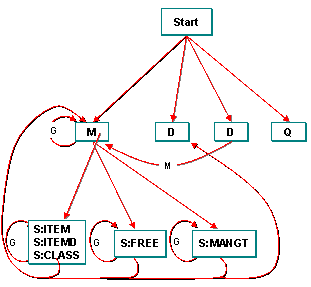
You can define nesting structures for repeating groups. The system checks the nesting. The syntax graph below illustrates valid nesting structures for repeating groups.
You can determine all valid structures by following the arrows.
Activities
WWI: Inserting Repeating Groups