 Programming Methods for Sub-Objects
Programming Methods for Sub-Objects
Use
If a business object type consists of sub-objects, you can implement the following standardized BAPIs to add or remove sub-objects:
This method adds a sub-object to an object type.
This method removes a sub-object from an object.
For example, to add or remove the sub-object purchase order item to the business object type purchase order, the BAPIs AddItem() and RemoveItem() could be implemented for the object type, purchase order.
The BAPIs Add<Name of sub-object>() and Remove<Name of sub-object>() are instance methods.
Features
BAPI Interface
Import Parameters
You should keep the following points in mind when defining the import parameters:
For further information see
 Test Run Parameters.
Customer Enhancements to BAPIs.
Change Parameters.
Test Run Parameters.
Customer Enhancements to BAPIs.
Change Parameters.
Export Parameters
You should keep the following points in mind when defining the export parameters of a Remove<name of sub-object>() BAPI:
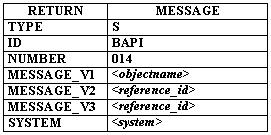
You should keep the following points in mind:

If the complete key exceeds the maximum capacity of MESSAGE_V2 (that is, 50 characters), it is divided up between the fields MESSAGE_V2 and MESSAGE_V3. The first 50 characters are stored in MESSAGE_V2 and the remaining characters in MESSAGE_V3.

The meaning of the various fields is the same as for successful execution.
For more information about this parameter, see
Return Parameters (Error Handling).
You should keep the following points in mind when defining the export parameters of an Add<name of sub-object>() BAPI:
Customer Enhancements to BAPIs.

The meaning of the various fields is the same as described in the programming model for the

The meaning of the various fields is the same as for successful execution.
For more information about this parameter, see
Return Parameters (Error Handling).
See also:
Example of an Add<Name of Sub-Object> BAPI