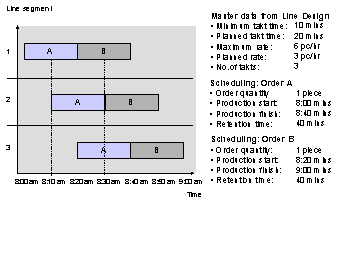
Example 2 for Takt-Based Scheduling
This example shows the scheduling of two planned orders each with an order quantity of 1. In this example, the maximum rate of the production line is used as the basis of takt-based scheduling. The planned production rate of the current period in this example is less than the maximum production rate.
Master data from line design
The production line consists of three line segments each with one takt. Every product must, therefore, flow through 3 takts, the number of takts is 3.
A maximum production rate of 6 pieces per hour is specified for the line hierarchy. This corresponds to a minimum takt time of 10 mins. The minimum takt time is the length of time it should take to process a material in one takt (also assembly line speed).
The planned production rate for the current period determined in line balancing is 3 pieces per hour. This means that every 20 minutes a material is placed on the production line in line segment 1.
Scheduling in Sequencing
Both orders are for 1 piece. Due to the planned production rate of 3 pieces per hour, however, one takt is left empty after each material. This empty takt is added to the orders resulting in a retention time (RT) of 40 minutes for each order:
RT = (3 takts - 1) * 20 mins +1 * 10 mins = 40 mins