 Service Calculation
Service Calculation
Use
This function enables you to calculate length of service for employees as part of the administration of retirement plans. Information about length of service is required for the following retirement plan calculations:
The third party administrators (TPAs) who calculate the expected retirement income for employees require service data as the basis for this calculation. Length of service can either be calculated within your SAP System and communicated to the TPA, or calculated by the TPA on the basis of relevant data that you provide (absence data, working time, employment dates, and historical accumulations of hours).
The following types of service are relevant for the calculation of projected retirement benefits:
This is credited to an employee for participation in a retirement plan and used to calculate projected retirement benefits.
This is credited to an employee for participation in a retirement plan and used to calculate projected retirement benefits. It determines the length of time that an employee has participated in a retirement plan for the purpose of calculating his/her projected retirement benefit.
This is credited to an employee for participation in a retirement plan and used to determine when an employee becomes vested in the plan, and the relevant vesting percentage.
Waiting periods for participation in retirement plans can be based on employee length of service (dynamic eligibility), in which case information about
Since eligibility service must be regularly calculated by means of a
dynamic eligibility check to ensure that the eligibility status of employees is up-to-date, this is always done in the SAP System rather than by the TPA.Prerequisites
If your organization requires employee length of service to be calculated using the hours counting method (see below), you must ensure that information about hours on the
Retirement Plan Cumulations infotype (0602) is complete for the period for which you are running the calculation. Prior to each seniority calculation, you therefore need run an extraction of payroll cumulations for a period in time that ends on the service calculation date.Data on the Retirement Plan Cumulations infotype (0602) must also be complete for the period for which you calculate eligibility service (see above) using the Dynamic Eligibility Check report.
Features
The calculation of each type of service can be flexibly defined to take account of your organization's policies regarding crediting of service. The algorithms used to calculate each type of service are defined by means of valuation models and calculation processes set up in Customizing. For more information about the definition of service calculation in Customizing, see the Benefits Implementation Guide (Plans ® Savings Plans ®
 Retirement Plan Service).
Either of the following methods can be used to calculate length of service:
This method determines length of service as the time that has elapsed since hiring or plan entry, taking into account interruptions in service, if required. It reads the relevant data from infotypes specified in Customizing.
You typically use this method to calculate the length of service of salaried employees (for whom no hours data is recorded).
This method determines length of service as the number of hours worked since hiring or plan entry. It reads the relevant data from payroll results that are stored after extraction on Retirement Plan Cumulations records (infotype 0602).
You typically use this method to calculate length of service for hourly-paid employees.

Interruptions in service can be taken into account by the system during calculation (for example, when calculating participation service). However, breaks in service are not automatically taken into account. Breaks in service are interruptions in service as a result of which previously accumulated service is nullified, and typically must be taken into account when calculating benefit accrual and vesting service.
If service is calculated by your TPA, breaks in service are taken into account as appropriate in the service amounts that are returned and stored in your system. However, if your TPA only calculates projected benefit amounts (in a partial service agreement) you should record breaks in service by manually adjusting the
The following graphic shows an example of service calculation using the elapsed time method:
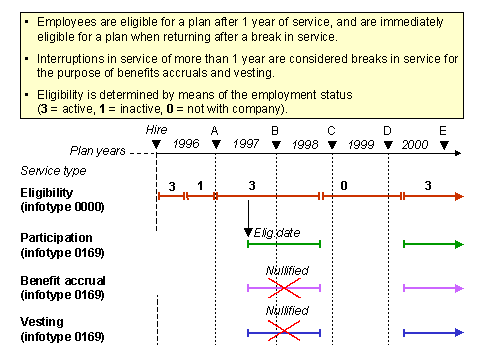
The following table shows the results calculated for this example at the end of each plan year (in this case calendar year) for each type of service:
Evaluation Date |
Eligibility Service |
Participation Service |
Benefit Accrual Service |
Vesting Service |
A (31 Dec 1996) |
6 months |
0 |
0 |
0 |
B (31 Dec 1997) |
not relevant |
6 months |
6 months |
6 months |
C (31 Dec 1998) |
not relevant |
15 months |
15 months |
15 months |
D (31 Dec 1999) |
not relevant |
15 months |
15 months |
15 months |
E (31 Dec 2000) |
not relevant |
24 months |
9 months |
9 months |
Activities
The results of service calculation are stored on the Retirement Plan Valuation Results infotype (0565). Each time you run a calculation, the system calculates length of service for the period between the current and last calculation key date (as inferred from the most recently calculated results stored on the infotype). It then adds the new result to the last calculation result and any manual adjustments on the last record, and stores the total in a new infotype record.
If you want to calculate service in your SAP System and send this data to a TPA, you need to ensure that you provide data for the appropriate valuation period. You therefore need to run the last service calculation prior to data transfer for the appropriate key date.