BOM Transfer: Example
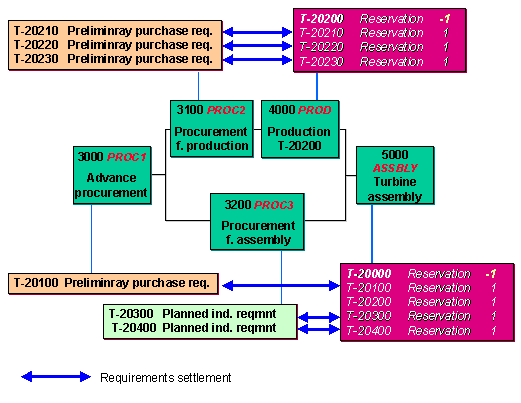
In this example we produce and assemble a turbine using a network. We assign the items from the two-level BOM to various network activities using BOM transfer.
Item T-20100 is a directly procured material (item category N) with a long delivery time. It is assigned via the reference
point PROC1 to activity 3000 "Advance procurement"The sub-items T-20210, T-20220, T-20230 for the production of assembly T-20200 are to be procured in activity 3100. Since these BOM items are all procured in the same activity, they have the same reference point PROC2.
Turbine assembly also requires material component T-20300 and T-20400 that are procured using MRP (
item category L). They are assigned via the reference point PROC3 to activity 3200.Assembly Items
Instead of using production orders, the production of assemblies can be modeled using
assembly items. In the transfer table you enter the project, the assembly to be produced and the reference point of the activity in which the assembly is produced.In this example, assembly T-20200 is produced in activity 4000 with reference point PROD, and turbine T-20000 is assembled in activity 5000 with reference point ASSBLY. The system assigns these assembly items with quantity -1 ("receipt from activity") and sets the requirements date to the finish date of the activity.
Allocation and Material Requirements Planning (MRP)
After you have defined reference points in the BOM and the network activities, and the assignment in transfer control, you execute the BOM transfer assignment program
You enter as selection parameters the Project definition, the Material T-20000 and set the Multi-level and Preliminary reqmnts indicators.
The system assigns the BOM items to the network activities and when the system
activates requirements, it generates reservations and preliminary requirements as follows:As illustrated in the following graphic, the system settles preliminary requirements against the reservations that are generated later. The prerequisite for this is that the material is managed in the same individual stock segment in both activities, that is. both activities are assigned to the same WBS element.