 NAND (NOT AND)
NAND (NOT AND)
When you use the NAND (NOT AND) operator, at least one statement must be false for the combined statement to be true. This operator is the same as using the statement NOT (A AND B).

1. |
(2 + 2 = 4) NAND Los Angeles is a city in California (FALSE) |
2. |
(2 + 2 = 4) NAND (10 < 6) (TRUE) |
3. |
(10 < 6) NAND (2 + 2 = 4) (TRUE) |
4. |
(2 + 3 = 4) NAND (10 < 6) (TRUE) |
The following table is the truth table for the NAND (NOT AND) operator.
Statement A |
Statement B |
A NAND B |
TRUE |
TRUE |
FALSE |
TRUE |
FALSE |
TRUE |
FALSE |
TRUE |
TRUE |
FALSE |
FALSE |
TRUE |
In the FI-SL application component, you use the NAND (NOT AND) operator when you want the system to check (1) first, that the data is not <x>, and (2) that the data is <y>, before the system uses the data.
The following graphic uses a truth table for the NAND (NOT AND) operator to determine if a transaction posts to a ledger.
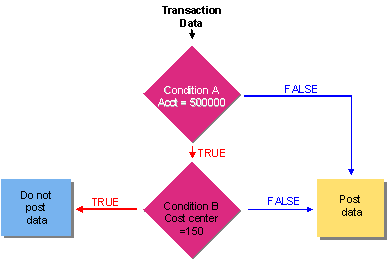
If the transaction is for account 500000 and cost center 150, then the combined statement is FALSE and the data is not posted to the ledger. If the transaction is not for account 500000 or not for cost center 150, then the combined statement is TRUE and the data is posted to the ledger.