 Allocation Segment
Allocation Segment
Definition
Summary of the rules for the allocation. The following information is summarized in an allocation segment:
Rules for sender objects
All values to be allocated that are determined according to the same rules are summarized for the sender objects.
Rules for receiver objects
All receiver trace objects that are determined according to the same rules are summarized for the receiver objects.
Use
You can define several segments within a cycle.
Overview: Sender values/receiver tracing factors per allocation
Allocation |
Sender values |
Tracing factors of the receiver objects |
Distribution |
- Posted amounts - Fixed amounts - Fixed rates |
- Variable portions - Fixed amounts - Fixed percentages - Fixed portions |
Assessment |
- Posted amounts - Fixed amounts - Fixed rates |
- Variable portions - Fixed amounts - Fixed percentages - Fixed portions |
Structure
An allocation segment consists of the following elements:
The segment header contains information that is valid for the whole segment. The sender and receiver rules determine how data records are assessed/distributed. You can find more information on allocation rules under
With the sender values, you can:
The segment header data determines the sender and receiver values for the segment.
You define sender and receiver object data, (cost center, account number, and business area, for example). You are able to use sets. For more information, see
Depending on the sender rule that you enter in the segment header, the following possible entries will be available to you for sender values: If you entered the sender rule
If you specified:

For more information, see
Example
The following graphic is an example of a simple allocation segment.
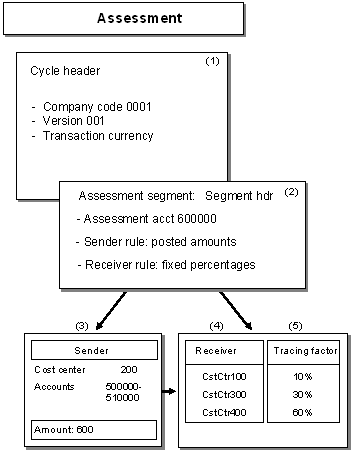
In this graphic
For a further example of allocation with segments, see
 Segment.